If your gas fireplace won’t turn on, the fix is usually one of five things: a dead pilot, a failed thermocouple or thermopile, a tripped safety, a dead battery in the igniter, or a gas supply interruption. Most of those are diagnosable in under ten minutes, and a few are safe to address yourself before calling anyone.
TL;DR
- Pilot won’t stay lit: almost always a dirty or corroded thermocouple, especially after a long idle season in San Diego.
- No spark at all: check the IPI igniter battery first (9V, inside the firebox control panel).
- Fireplace lights then shuts off after a few minutes: failing thermopile, a common San Diego corrosion issue.
- Wall switch or remote not responding: dead battery or a failed receiver module, both homeowner-fixable.
- Gas smell or a hiss: stop, shut the gas valve, leave the house, and call from outside.
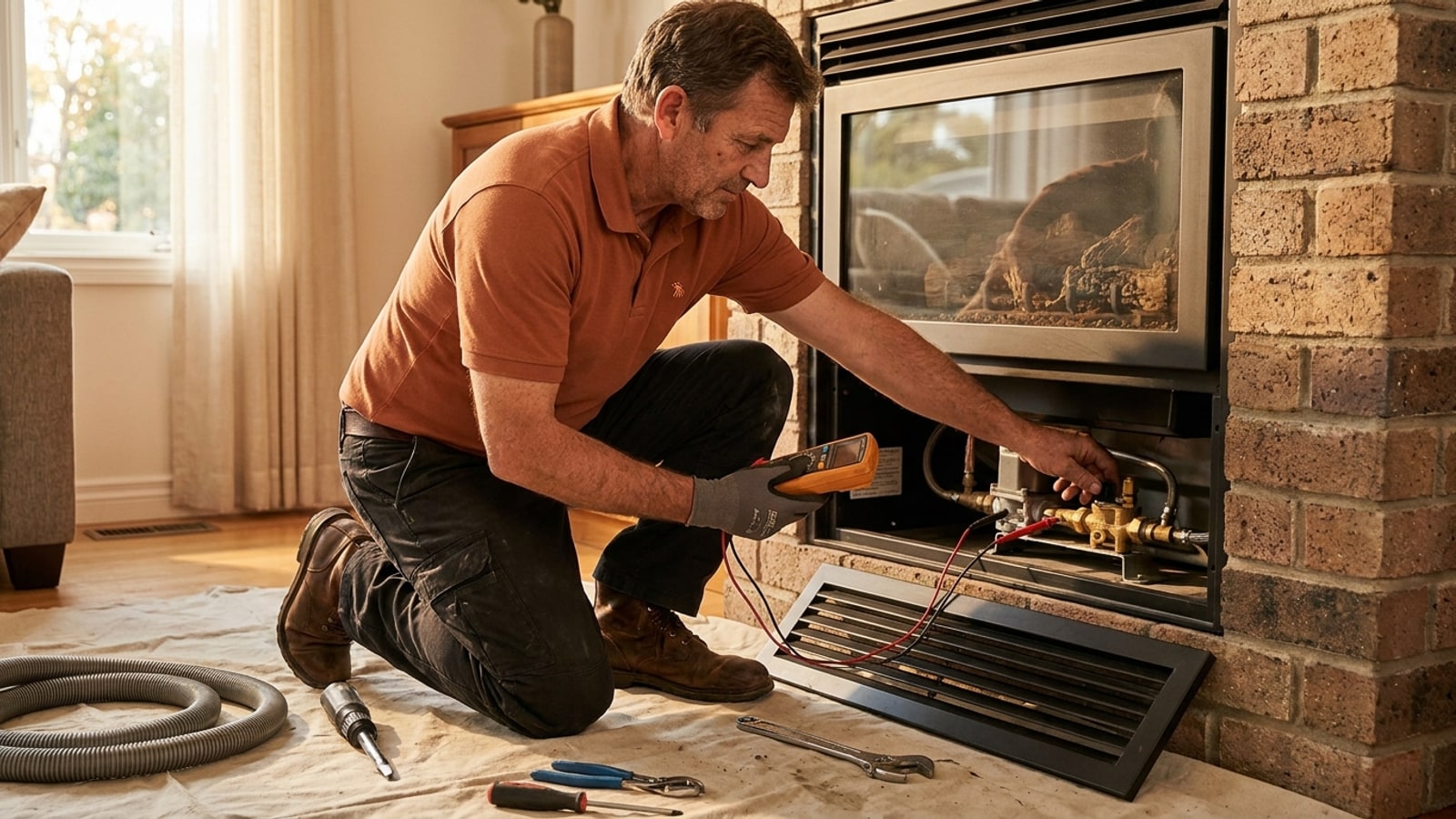
Why won’t my gas fireplace turn on?
There are eight common reasons, and they’re worth checking in order. The first few are free to diagnose yourself. The last few need a tech.
San Diego’s climate shapes which causes show up most. Most homes here run a gas fireplace a dozen evenings a year, tops, then let it sit from April through November. Idle months plus the marine layer that rolls in from the coast mean parts fail from corrosion and neglect, not hard use. That’s a different failure pattern than a Minnesota home that burns every night all winter, and it affects which causes to check first.
Is the pilot light still on?
Start here. If your fireplace uses a standing pilot (a small always-on flame), open the firebox and look for a small blue flame near the burner. No flame means the pilot is out.
Relighting a standing pilot is usually safe for a homeowner to do. The lighting instructions are on a label inside the firebox or on the control valve body. The sequence is: set the valve to “pilot,” press and hold the knob, then press the igniter button until the pilot catches. Hold the knob down for 30 seconds after the pilot lights to heat the thermocouple, then slowly release.
If the pilot won’t catch, the orifice is probably clogged. Spider webs are the number-one culprit in San Diego. The burner box sits dark and idle for months, and spiders find the small pilot tube inviting. A clogged orifice needs cleaning with compressed air or a fine probe, which is a pro-level step.
If the pilot catches but dies the second you release the knob, the thermocouple is the issue. Keep reading.
Why won’t my pilot light stay lit?
The thermocouple is a small metal rod that sits directly in the pilot flame. It generates a tiny voltage when heated, and that voltage tells the gas valve it’s safe to stay open. When the thermocouple is cold, corroded, or out of position, the voltage drops and the valve shuts off as a safety measure.
In San Diego, a thermocouple that worked fine last spring often fails by the following winter. The marine layer from La Mesa to Encinitas introduces enough salt moisture to corrode the tip over nine idle months. The fix is a thermocouple replacement, which runs $150–$300 with labor and is usually the first thing the pros in our San Diego network check on a standing-pilot unit.
Thermopile problems show up differently. A thermopile is a larger version of the thermocouple used in millivolt-controlled systems. It generates more voltage to power the valve and sometimes a wall thermostat. If your fireplace lights then shuts off after a few minutes, the thermopile is failing. A tech can test it with a millivolt meter in two minutes. Replacement runs $200–$400.
Did you check the IPI igniter battery?
Newer gas fireplaces use an Intermittent Pilot Ignition (IPI) system instead of a standing pilot. The IPI igniter only lights when you call for heat, and it runs on a 9V battery tucked inside the control panel at the base of the firebox.
A dead battery is one of the most common reasons a gas fireplace with IPI won’t respond at all. No click, no spark, no reaction. You press the remote or wall switch and nothing happens.
Open the small panel at the bottom of the firebox, pull the battery, and replace it. That’s a homeowner fix that takes two minutes and costs under $5. If a fresh battery doesn’t restore the spark, the igniter module or igniter electrode is likely the issue, and that’s a tech call.
Is the wall switch or remote the problem?
Gas fireplaces in San Diego homes built after 2000 typically run on a wall switch or a remote receiver. Both can fail in ways that have nothing to do with the gas system.
For a wall switch that controls the fireplace, the switch itself can fail. It’s a millivolt switch, not a standard light switch, and the contacts corrode. Swap it for a new one (they’re inexpensive) before assuming the gas valve is bad.
For a remote control setup, there’s a receiver module inside or behind the firebox. The receiver has its own battery, usually AA cells in a small box. Dead batteries in the receiver are a common cause of a fireplace that won’t respond to the remote. Replace them first. If a fresh battery set doesn’t help, the receiver module may need replacing, which runs $150–$400.
Could a safety shutoff have tripped?
Gas fireplaces have a high-limit safety device that cuts off gas flow if the unit overheats. In a fireplace that rarely runs, this is uncommon. But if someone left the fireplace on for an extended period or the air circulation was blocked, the safety may have tripped.
Some high-limit switches reset automatically after the unit cools. Others need a manual reset, often a small button somewhere on the valve body. If you’ve checked everything else and the fireplace still won’t fire, a tech can test the safety switch in minutes.
A blocked flue or vent can also trigger safety shutoffs. If the exhaust path is restricted, gases back up, temperatures rise, and the safety interrupts operation. If you haven’t had a chimney inspection in the past year, that’s worth scheduling alongside the repair call.
What if the gas supply is the issue?
Before you go too deep into fireplace diagnostics, verify the gas is actually on.
Check the shutoff valve on the gas line behind or below the fireplace. It’s a quarter-turn valve: the handle should be parallel to the gas line to be open, and perpendicular to be closed. If another repair recently touched that area, the valve may have been shut and not reopened.
Also check your other gas appliances. If the stove burners won’t light and the water heater is cold, you may have a service interruption from SoCalGas or a problem with the main supply. Call SoCalGas if nothing in the house has gas.
If only the fireplace is affected and the shutoff valve is open, the internal gas valve may have failed. A gas valve replacement runs $350–$650 and is the most expensive common repair. A tech will confirm it’s the valve before recommending a replacement.
Is a blocked vent stopping the fireplace from firing?
Modern gas fireplaces have sensors that detect vent restriction or backdraft and shut off the unit. If a bird’s nest, fallen debris, or a damaged vent cap is partially blocking the exhaust, the fireplace may refuse to stay on as a safety response.
San Diego’s idle-season vents are a real target for animals. A flue that sits unused from April to November is an open invitation. Look at the exterior vent termination and see whether anything is visibly blocking it. If you can’t check it safely, include a vent inspection when you schedule the service call. Our post on why a gas fireplace runs but shuts off covers this failure mode in more depth.
When should I stop and call a pro?
You can safely handle a few things yourself: relighting a standing pilot, swapping the IPI or remote receiver battery, replacing a wall switch, and checking the gas shutoff valve. That covers a surprisingly large slice of no-start problems.
Everything else, including thermocouple and thermopile work, gas valve testing or replacement, igniter module replacement, and any vent work, should go to a licensed tech. Any time you open the gas valve assembly or disturb a fuel line connection, you’re introducing the possibility of a slow leak. A gas leak indoors is a fire and carbon monoxide risk, and manufacturer warranties void fast when an unlicensed person touches the valve.
If you smell gas at any point: stop, shut the gas off at the shutoff valve, open a window, leave the house, and call from outside. Don’t flip any switches.
For a full look at what the techs in our San Diego network check and what typical repairs cost, see our gas fireplace repair in San Diego guide. And if smoke or strange smells are part of the problem, our why your fireplace smokes into the room post covers the draft and vent angle in detail.
When you’re ready to have someone look at it, the pros we connect you with handle gas fireplace repair across all of San Diego County, from Carlsbad down to Chula Vista.
Frequently asked questions
Why won’t my gas fireplace turn on after sitting unused all summer? Corrosion is the most common cause in San Diego. The marine layer settles on the thermocouple tip and pilot orifice over idle months and disrupts both ignition and the safety circuit. A cleaning or thermocouple swap usually fixes it.
My gas fireplace clicks but won’t light. What’s wrong? The spark is reaching the electrode but not catching flame. The pilot orifice is likely clogged (often a spider web or dust), or the electrode gap has shifted. Both are quick fixes on a service call.
How do I know if my thermopile is bad? The clearest sign is a fireplace that lights and runs for a few minutes, then shuts off. A tech can test the thermopile with a millivolt meter in under five minutes. If the reading is below spec, replacement is the fix.
Gas fireplace repair near me: what does it cost in San Diego? Most repairs run $150–$650 in San Diego County in 2026, not counting the $100–$200 service call that most shops credit toward any repair. Thermocouple and pilot jobs sit at the low end. Gas valve replacements sit at the high end.
Get your gas fireplace working again
If you’ve worked through the DIY checks and the fireplace still won’t turn on, it’s time for a pro. The techs in our San Diego network carry the common replacement parts, give upfront pricing before opening anything, and service all of San Diego County.
Call us at (858) 925-5546 for a same-day estimate.