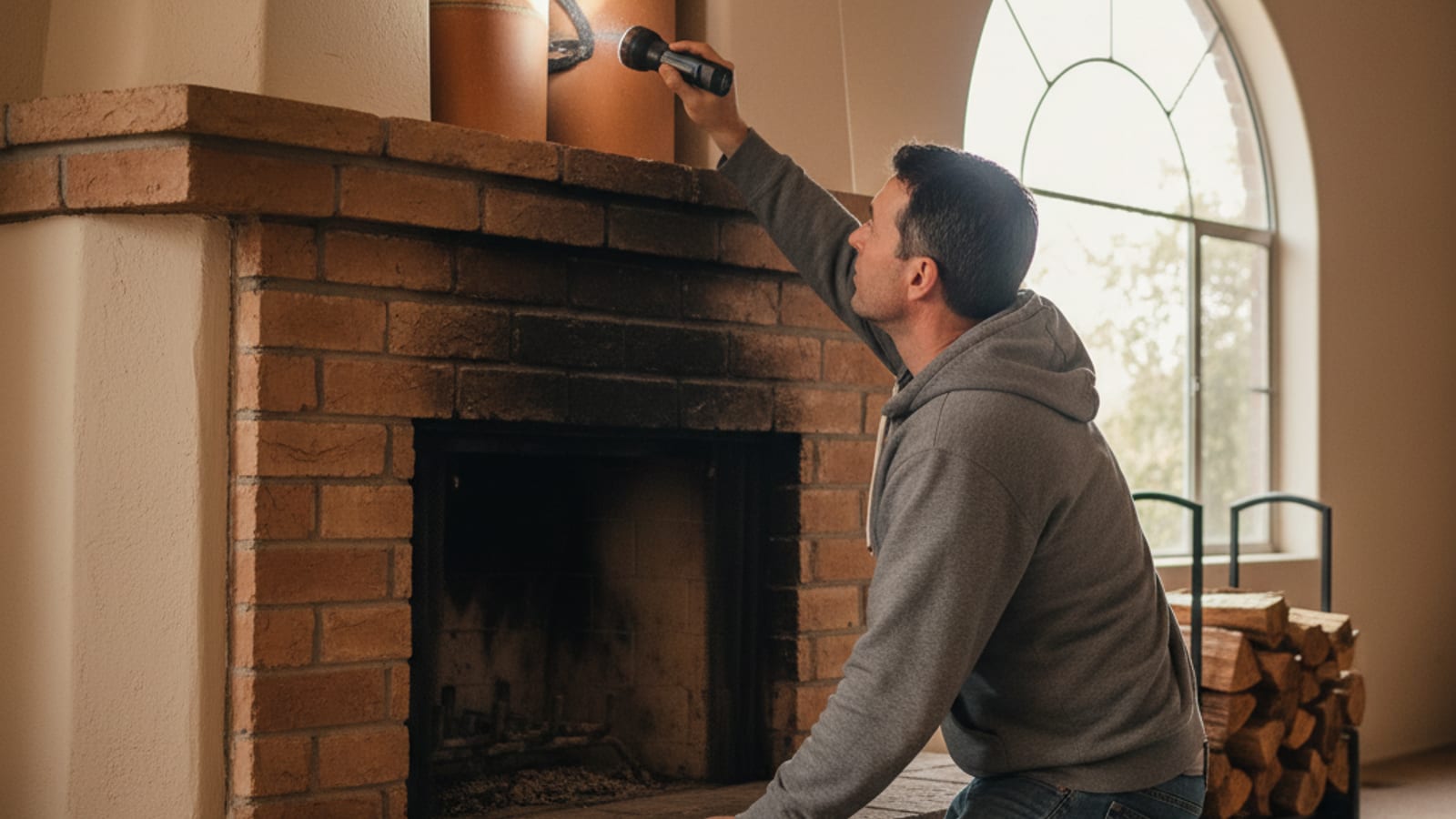
Smoke spilling into the room from a fireplace is the most common troubleshooting call we get. Sometimes it’s a five-minute fix you can handle yourself. Sometimes it’s a sign of a serious flue or chimney problem. Here’s how to diagnose what’s actually wrong, ranked from easy to expensive.
First check: is the damper fully open?
The most common smoke spillage problem is the damper isn’t fully open. The damper handle in the firebox usually has three positions, closed, partially open, fully open. Partially-open dampers are a holdover from the days of open damper handles being used as draft control. Modern wisdom: when you have a fire, the damper is fully open.
Reach up and physically check that the damper plate is all the way open. If you can’t tell, look up past it with a flashlight, you should see the smoke shelf and the bottom of the flue clearly.
If the damper handle is rusted, stuck, or won’t move to fully open, that’s a damper repair (covered below).
Five-minute fix.
Second check: is the flue cold?
A cold flue has a column of cold dense air sitting in it. When you light a fire, the warm smoke can’t push that cold air column up and out, so it spills back into the room until the flue warms up.
Fix: prime the flue before lighting the main fire. Roll up a single sheet of newspaper into a tight torch, light one end, and hold it under the open damper for 30 seconds. The flame and hot air warm the flue and start the draft. Then light the main fire normally.
If priming the flue solves the smoke problem, you don’t have a chimney problem, you have a cold-flue problem. Just prime every time before lighting.
Five-minute fix.
Third check: is the house under negative pressure?
Modern tightly-sealed homes can develop negative interior pressure, especially when a kitchen or bathroom exhaust fan is running. Negative pressure means the chimney is the path of least resistance for outside air to get in, so air flows down the chimney instead of up, taking smoke with it.
Test: open a window slightly (1–2 inches) on the windward side of the house. Light the fire. If smoke spillage stops, you have a negative-pressure issue.
Long-term fix options:
- Open a nearby window for the first 10 minutes of every fire
- Turn off bathroom and kitchen exhaust fans before lighting
- Install a top-mount damper that seals when closed (also saves year-round energy)
- Install a make-up air kit (advanced, needs an HVAC pro)
Easy DIY workaround. Long-term fix may need a pro.
Fourth check: is the chimney cap or flue blocked?
Animal nests, fallen debris, and fallen mortar chunks all block the flue. Symptoms: smoke spillage that’s gotten worse over time, a “dead animal” smell from the firebox, scratching or chirping sounds when there’s no fire.
DIY check: shine a flashlight up the open damper. You should see a clear path up the flue with no obstructions, no nesting material, no animal sounds.
Pro check: a $89 inspection with a camera scan finds blockages anywhere in the flue, including past the smoke chamber where DIY can’t see.
If there’s a blockage, stop using the fireplace until it’s removed. A partial blockage that lets the fire keep burning is also concentrating combustion gases, including carbon monoxide, back into the room.
Fifth check: is the smoke chamber rough or oversized?
The smoke chamber is the triangular space inside the chimney above the firebox and damper, before the flue starts. In older San Diego homes (pre-1970), smoke chambers were built with corbel-step construction, rough stair-stepped brick that disrupts smoke flow on its way up. Modern code requires the smoke chamber to be parged (smoothed with refractory mortar) for proper draft.
Symptoms: smoke spillage even after damper is fully open and flue is warm. Slow draft on every fire. Visible heavy creosote accumulation on the smoke chamber walls during sweep service.
Fix: smoke chamber parging. The pros we send apply refractory mortar to the rough brick steps to create a smooth tapered surface that lets smoke flow up cleanly. One-day job, $650–$1,200, dramatic improvement on draft.
Sixth check: is the chimney too short?
Chimneys need to extend high enough above the roof and any nearby roof peaks to get above the turbulent air around the building. NFPA 211 requires:
- 3 feet above the roof penetration
- 2 feet above any portion of the roof within 10 feet horizontally
If your chimney doesn’t meet that 3-and-2 rule, it’s likely sitting in a turbulent air zone where downdrafts cause persistent smoke spillage.
Fix options:
- Wind-baffle (windcap) cap: $345–$425 installed. Uses wind to actively pull air up the flue. Solves most short-chimney problems.
- Chimney extension: $800–$2,000+ depending on additional height needed. Adds masonry or metal flue sections to bring the chimney into compliance.
A short chimney that’s never had problems likely has favorable wind patterns. A short chimney with chronic smoke spillage probably won’t fix itself, needs a wind cap or extension.
Damper repairs
If the damper handle is rusted shut, the damper plate is warped, or the damper frame is rusted out, that’s a damper repair.
Throat damper repair (the original cast iron or steel damper inside the firebox): handle assembly, plate replacement, or full damper replacement. $245–$650 depending on the model and damage.
Top-mount damper installation (replacing a failed throat damper with a new damper that seals at the top of the chimney): $595–$895 installed. Bonus: top-mount dampers seal far better than throat dampers, they save energy year-round by keeping conditioned air from escaping up the chimney when the fireplace isn’t in use.
For homes where the original damper is shot, top-mount is often the better answer. Better seal, easier to operate (cable down to the firebox), and a 20+ year service life.
Bottom line: diagnostic order
- Damper fully open? (5-minute fix)
- Prime the flue with a paper torch before lighting? (5-minute fix)
- Open a window slightly to test for negative pressure? (5-minute test)
- Visible blockage looking up the flue? (Stop using until inspected)
- Heavy creosote on the smoke chamber from past inspections? (Smoke chamber parging, pro fix)
- Chimney shorter than 3 feet above the roof? (Wind cap or extension, pro fix)
If steps 1–3 don’t solve it, schedule a $89 inspection. We do a smoke pencil test, camera scan, and damper check in one visit. The fee is credited toward any repair work that follows.
Call us at (858) 925-5546.