Chimney rebuild cost in San Diego runs $4,800–$7,500 for a partial rebuild above the roofline and $8,000–$15,000+ for a full rebuild from the firebox or footing. The difference between those two numbers comes down to how far the damage extends below the roof deck.
This guide covers what you get at each price point, when a rebuild makes more sense than continued repairs, and what San Diego’s older housing stock adds to the conversation.
TL;DR
- Partial rebuild above the roofline: $4,800–$7,500. New brick, new mortar, new crown and cap, from the roof up.
- Full rebuild from the firebox: $8,000–$12,000. Includes opening the firebox and rebuilding the smoke chamber and throat.
- Full rebuild from the footing: $12,000–$15,000+. Required when the foundation has shifted or the lower masonry is failing.
- Older unreinforced masonry chimneys in North Park, Kensington, and similar neighborhoods often need seismic anchoring as part of any rebuild.
- San Diego County requires a permit for structural chimney work. Budget 4–6 weeks for permit processing.
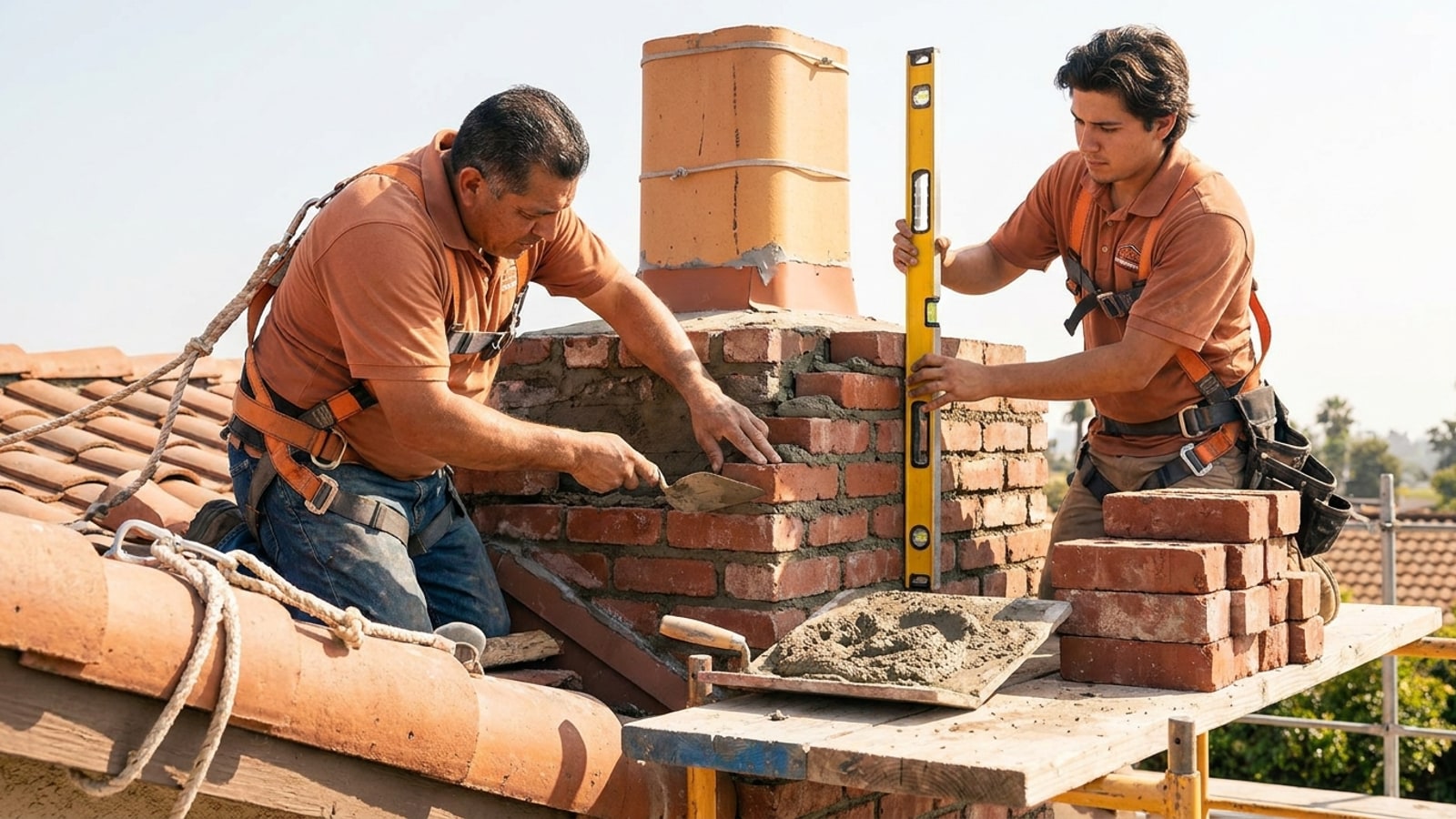
How much does it cost to rebuild a chimney in San Diego?
The most common scenario is a partial rebuild above the roofline. Most San Diego chimneys that fail do so in the upper third, the section above the roof deck exposed to sun, salt air, and the occasional freeze-thaw cycle in inland zones. Below the roofline, protected by the attic and walls, the masonry typically holds up longer.
Partial rebuild above the roofline: $4,800–$7,500. This includes demolition of the failing courses, new brick or block-and-stucco depending on the original construction, new mortar, new reinforced concrete crown, and new stainless steel cap. Most jobs run two to three days on site.
Full rebuild from the smoke chamber or firebox: $8,000–$12,000. Required when the damage extends below the roofline into the smoke chamber, the firebox walls, or the throat damper area. Includes everything in the partial rebuild plus firebox brick and smoke chamber parge coat or rebuild. Permits required. Typical timeline: two to four days on site plus cure time.
Full rebuild from the footing: $12,000–$15,000+. Required when the foundation has moved, when structural cracking runs through the full height of the chimney, or when more than 60% of the masonry has failed. Includes structural assessment, possible footing work, full demolition, and full rebuild from grade. At this price point it’s worth pricing a direct-vent gas conversion as an alternative.
All prices assume standard access from the roof. Steep pitch, difficult site access, or multi-story homes add $500–$1,500.
Brick vs. block-and-stucco: does the material change the cost?
It does, some. Brick rebuilds run slightly higher because brick is slower to lay and requires more skilled labor to match original coursing and joint profile.
Traditional brick rebuild (above roofline): $5,500–$7,500. Used when the original chimney is brick, the homeowner wants to match the existing aesthetic, or when local code or HOA requires it. Red clay brick is the most common in older San Diego construction.
Block-and-stucco rebuild (above roofline): $4,800–$6,500. Concrete masonry unit (CMU) block core with stucco finish. Standard on post-1970 construction, stronger in shear than unreinforced brick, and slightly less expensive. Can be tinted or textured to match.
Either material, the structural performance is roughly equivalent when built to current code. The choice is mostly aesthetic and dictated by what the existing chimney looks like.
What else comes with a rebuild?
A chimney rebuild above the roofline includes a new crown and cap by default. Both are part of any responsible masonry job because they’re already accessible and the labor is already there.
Crown: included or $950–$2,400 standalone. A reinforced concrete crown with proper overhang, drip edge, and polyethylene bond break. This is the right crown, built correctly. For more on crown options, see our guide on chimney crown repair vs. rebuild.
Stainless steel cap: included or $225–$650 standalone. A properly sized single or multi-flue cap with spark arrester mesh. California Building Code requires spark arrester mesh on chimneys serving solid fuel in WUI (Wildland-Urban Interface) zones, and most of inland San Diego County qualifies.
Flashing: add $450–$1,400. Flashing is almost always disturbed during a partial rebuild and should be replaced at the same time. Step flashing tucked under the shingles plus counter flashing set into a reglet in the masonry. If the flashing is already failing, this is the moment to address it.
If the flue liner is cracked or missing sections, a stainless reline adds $2,400–$4,500 on top of rebuild costs. The masons in our San Diego network will pull a camera scan before work begins to confirm liner condition.
When does a rebuild beat continued repairs?
The turning point is usually around three rounds of repairs in 10 years or a single repair estimate above $3,500. At that point, the math on a partial rebuild often works in the homeowner’s favor over a 10-year horizon.
Concrete examples:
- Tuckpointing at $1,200, crown coat at $600, and cap replacement at $250 over seven years = $2,050 in repairs, with the crown now failing structurally and the brick spalling at the top courses. A partial rebuild at $5,500 resets the clock for 30+ years.
- A second flashing repair, a second crown coat, and a soft spot appearing in the upper brickwork is a strong signal that the upper chimney is too deteriorated for further patching to hold.
The guiding principle is the same as with any repair vs. replace decision: if the repairs are addressing symptoms without fixing the structure, you’re in a cycle. A camera scan and written condition assessment from a licensed mason will tell you where you are.
For a full breakdown of repair costs by type, see our chimney repair cost guide for San Diego.
What about older unreinforced masonry chimneys?
This is where San Diego’s housing stock introduces a real variable. Neighborhoods like North Park, Kensington, and older pockets of La Mesa and Point Loma have housing built decades ago. Chimneys from that era are typically unreinforced masonry, meaning no internal rebar, no seismic anchoring, and mortar that’s had 60 to 80 years to degrade.
Under California seismic guidance (and referenced in the California Building Code), unreinforced masonry is a known hazard in earthquake zones. San Diego is Seismic Zone 4. An unreinforced masonry chimney that’s already compromised structurally is a falling hazard in a significant seismic event.
What this means for rebuild costs:
Seismic anchoring during rebuild: add $800–$2,500. When rebuilding a chimney on a pre-1960 home, the masons in our network will typically tie the new masonry back to the framing with seismic straps or lag-bolted angle iron brackets. This is increasingly expected by building inspectors in San Diego County and is simply the right practice on older homes.
Full seismic retrofit of existing chimney (without full rebuild): $1,800–$4,500. A less common approach: brace the existing chimney in place with a steel frame without demolishing. This is a viable option when the masonry itself is still sound but the chimney is tall and untethered. Requires engineer review.
If you’re not sure whether your chimney is unreinforced masonry, the pre-1960 rule of thumb is a good starting point. Our chimney repair service includes a structural assessment as part of the written inspection report.
Does a chimney rebuild require a permit in San Diego?
Yes. Any structural chimney work in San Diego County, including a partial rebuild above the roofline, requires a building permit. This is not optional and not a contractor preference; it’s California Building Code and San Diego County Code.
Practical notes:
- Permit processing: 4–6 weeks through the County (unincorporated areas) or the relevant city building department. Cities like La Mesa and El Cajon have their own permit processes.
- Cost: $350–$800 in permit fees depending on scope and jurisdiction.
- Inspection required at rough-in stage (if firebox work is involved) and at completion.
Contractors who quote chimney rebuilds without mentioning permits are a flag. Verify that any contractor you hire is carrying CSLB licensure appropriate for structural masonry work: a C-29 masonry license or a B general contractor license. You can verify at the CSLB website.
Our masonry repair service page has more on what to look for when evaluating masonry contractors in San Diego County.
What does the rebuild process actually look like?
It helps to know what you’re agreeing to before work starts.
Day 1: Scaffold or rooftop access setup. Chimney cap and crown removed. Upper courses of brick demolished carefully, staged to avoid debris falling into the firebox or onto the roof. Any flashing disturbed is stripped for replacement.
Day 2: New brick courses laid. Tuckpointing matched to existing mortar color and joint profile. New flashing installed. Depending on scope, this may extend to day 3.
Day 3 (or final day): Crown formed and poured. New cap set. Flashing sealed. Inspection walk with homeowner.
Cure period: Mortar and crown concrete should cure 24–72 hours before lighting a fire. Full mortar cure is 28 days, but the chimney is safe to use carefully after 72 hours.
For related reading on our specific masonry services, see our chimney crown repair page and our post on chimney masonry and tuckpointing in San Diego.
Frequently asked questions
What is “chimney rebuild above the roofline” and is it the same as a full rebuild? No. A partial rebuild above the roofline only demolishes and rebuilds the section of chimney that sits above the roof deck, typically the top 4–8 feet. A full rebuild goes to the firebox, smoke chamber, or footing. Most San Diego homeowners need the partial rebuild. The full rebuild is required when structural damage extends below the roofline.
Can I get a chimney rebuild cost estimate without someone coming out? Not a reliable one. Rebuild cost depends on the number of brick courses above the roofline, material match, flashing condition, liner condition, chimney height, and roof pitch. A phone estimate is a rough bracket at best. A camera scan and roof-level inspection ($89) produces an itemized written estimate you can actually compare.
Do I need a permit for a partial chimney rebuild? Yes, in San Diego County. Any structural masonry work, including partial rebuilds above the roofline, requires a building permit. Budget 4–6 weeks for permit processing and $350–$800 in permit fees. Skipping the permit creates problems when you sell the property or file an insurance claim.
Will the new brick match my existing chimney? With a partial rebuild, matching is possible but not guaranteed. The masons in our network work with current brick stock and mortar pigments to get close, but 50-year-old brick has weathering and patina that new brick won’t replicate exactly. If an exact match matters to you, discuss it before work begins. Some homeowners choose to paint or stucco the full chimney after a partial rebuild to unify the appearance.
Ready to get an estimate?
If your chimney is showing structural cracks, spalling brick in the upper courses, or has been repaired multiple times without lasting results, a rebuild conversation is worth having. The masons in our San Diego network work on chimneys from Chula Vista to Escondido and are familiar with the older unreinforced masonry stock in central San Diego neighborhoods.
Call us at (858) 925-5546 for a same-day estimate.