Chimney flashing repair cost in San Diego runs $150–$350 for a reseal and $450–$900 to strip and replace step and counter flashing. If your chimney is wider than 30 inches and needs a cricket, add $350–$700 on top of the replacement. Those are the real numbers for 2026.
If you’re not sure whether you have a flashing leak at all, read our post on how to tell if it’s the flashing or the crown before you book anything.
TL;DR
- Reseal with caulk or sealant: $150–$350. Temporary. Buys time, not a fix.
- Strip and replace step + counter flashing: $450–$900. The real repair.
- Add cricket fabrication: $350–$700 extra for chimneys wider than 30 inches.
- Coordinated during a roof replacement: same price range, often better outcome and a cleaner warranty.
- Flashing leaks are the most common chimney leak in San Diego. Diagnose before you spend.
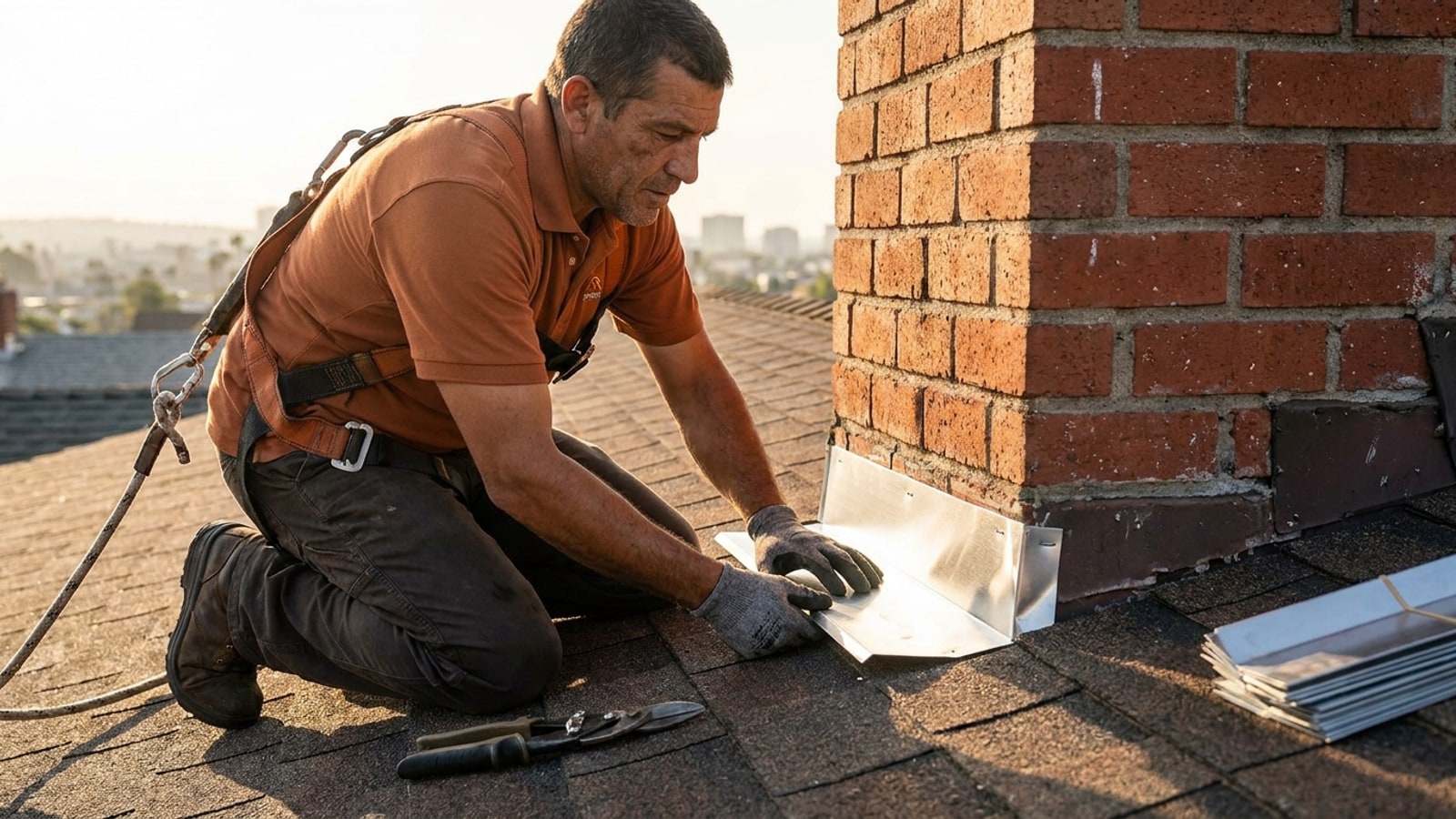
How much does chimney flashing repair cost in San Diego?
The short answer: $150–$1,400, depending on the scope. Here’s the breakdown:
- Reseal (caulk or polymer sealant): $150–$350
- Strip and replace step + counter flashing: $450–$900
- Strip and replace with cricket fabrication: $800–$1,600 total
- Coordinated reroof flashing (new roof + reflash): $450–$900 for the flashing portion, billed alongside the roof
Most jobs in La Mesa, Santee, and inland Escondido fall in the $500–$750 range, strip-and-replace on a standard single-story brick chimney with moderate shingle work. Coastal homes with steeper pitches or older brick typically land in the upper half of that range.
What’s the difference between step flashing and counter flashing?
These two terms come up on every estimate. They’re not the same thing, and a repair that fixes only one of them will still leak.
Step flashing is the series of L-shaped metal pieces that tuck under each shingle course going up the side of the chimney. Each piece overlaps the one below it. The shingles sit on top, which keeps water from getting under the flashing. Step flashing is part of the roofing layer.
Counter flashing is the second layer. It’s embedded (or “set”) into the masonry above the step flashing and bends down over it. It covers the top edge of the step flashing and keeps water from running behind it down the brick face. Counter flashing is part of the chimney.
When both are done right, water hits the counter flashing, diverts to the step flashing, and runs off the roof. When only caulk is holding the system together, and the caulk fails (it always does), water finds its way behind the step flashing and into the house.
Why does “just caulk it” fail?
Reseal jobs come in at $150–$350 and there are situations where they make sense: you’re selling the house in six months, your roofer is replacing the roof in the spring and will handle the flashing then, or the step flashing itself is still in good shape but the lap seal dried out.
Outside of those scenarios, caulk is a temporary patch, not a repair. Here’s why it fails:
- Sealant is rated for a 5–10 year surface life under UV and thermal cycling. On a San Diego roof that sees 150+ degree surface temperatures in summer, expect 3–5 years before it cracks.
- When L-flashing is wrapped around the brick face and sealed with caulk at the top edge, every season’s worth of brick expansion and contraction works the bond loose. You get a gap, water runs behind it, and the stain comes back.
- Caulk over a gap doesn’t address the geometry. If the step flashing is missing, undersized, or improperly lapped, sealant can’t compensate.
A proper strip-and-replace solves the geometry instead of trying to seal around it.
What is reglet-set counter flashing and why does it matter?
On any quality flashing job, the counter flashing isn’t just bent against the brick face and caulked. It’s set into a saw-cut groove called a reglet, cut horizontally into the mortar joint about 1.5 inches deep. The counter flashing is bent into the reglet and locked in place with expansion anchors or lead wedges, then sealed with a flexible polymer sealant inside the groove.
The difference matters:
- Surface-applied counter flashing (bent against the brick and caulked): the caulk is the only thing keeping water out. When it fails, the entire counter flashing lifts away from the brick and the step flashing is exposed.
- Reglet-set counter flashing: the flashing is mechanically anchored into the masonry. The sealant at the reglet is protected from UV. It lasts much longer, and if the sealant eventually cracks, the mechanical anchor still holds the flashing tight.
The pros in our San Diego network use reglet-set counter flashing by default on any strip-and-replace job. If you’re getting a quote and the contractor isn’t mentioning a saw-cut reglet, ask about it directly.
Does my chimney need a cricket?
A cricket (also called a saddle) is a peaked wedge of flashing built on the upslope side of the chimney, behind it from your perspective on the ground. It diverts water and debris around the chimney instead of letting it pile up against the upslope flashing.
California’s current residential building code requires a cricket on chimneys wider than 30 inches measured perpendicular to the roof slope. That covers a lot of the older brick chimneys in San Diego.
Without a cricket on a wide chimney, you get a dam effect: leaves, debris, and standing water collect behind the chimney, the step flashing on that side is constantly under hydrostatic pressure, and it fails faster than the rest of the system.
Cricket fabrication adds $350–$700 on top of the strip-and-replace price. It’s sheet metal work, custom-formed to your chimney geometry and roof pitch. The total for strip-and-replace with cricket typically runs $800–$1,600. It’s not a small number, but it’s significantly less than the ceiling and drywall work that follows if the chimney keeps leaking.
How does flashing repair work with a roof replacement?
This is the cleanest scenario, and if you’re getting a new roof in the next year or two, it’s worth coordinating the timing.
When the roofer tears off the old shingles, the step flashing comes off too, because each piece is interwoven with the shingles. That’s the right moment to install new step flashing. The counter flashing can be done before or after the new shingles, depending on the sequence.
Coordinating this with a chimney specialist (rather than leaving it entirely to the roofer) matters because:
- Most roofers install L-flashing bent against the brick and caulked, not reglet-set counter flashing. That’s within code for re-roof work in most San Diego jurisdictions, but it’s not the same quality.
- A chimney specialist can handle the counter flashing correctly, coordinated with the roofer’s schedule, for the same $450–$900 range.
- One warranty, one responsible party, no “that was the other contractor’s scope” conversations if it leaks.
The pros in our network work alongside roofers on coordinated jobs regularly. If you’re getting roof bids, we can sync the schedule.
How does a flashing leak get misdiagnosed as a crown leak?
This is one of the more common diagnostic mistakes. Both sources can produce water stains on the ceiling near the chimney, and both get worse after heavy rain.
The distinction is in where the water shows up. A crown leak typically produces water on the smoke shelf (inside the firebox cavity, at the back wall above the damper) and vertical staining on the upper brick face. A flashing leak typically shows up as ceiling stains along the roofline where the chimney passes through, and sometimes as staining in the attic framing at that same intersection.
But if a flashing leak has been going on for a while, the water saturates the chimney masonry and can track down through the brick, producing staining patterns that look like a crown problem. The chimney hasn’t been diagnosed correctly, so the homeowner pays for a crown coat that doesn’t stop the leak.
The hose test described in our chimney leak diagnosis guide isolates which source is active. It takes 60–90 minutes and you should never approve a repair without it.
For a broader look at what chimney repairs cost beyond flashing, see chimney repair cost in San Diego.
Frequently asked questions
How long does chimney flashing last? Aluminum flashing with a reglet-set counter flashing installation typically runs 25–40 years. Galvanized flashing (the older standard, common on pre-1990 homes) rusts faster, especially near the coast. 15–20 years is realistic for galvanized in San Diego’s salt air. Copper lasts 50+ years and is the highest-cost option, usually reserved for custom or historic homes.
Can I just use chimney flashing sealant from a hardware store? Temporarily, yes. Eternabond tape or a high-grade polymer chimney sealant can slow an active leak while you schedule the real repair. It won’t fix the underlying geometry or replace failed step flashing, so treat it as a stopgap. If you’re planning a roof replacement within 12 months, that’s a reasonable window for a reseal to hold.
Does flashing repair require a roofing contractor license? In California, working on the flashing at a chimney-roof junction typically requires a C-39 roofing license because it involves the roofing assembly. Verify the contractor’s license at the CSLB before any flashing work begins. A chimney specialist and a licensed roofer can also collaborate, with each handling their respective scope.
How do I know if I need strip-and-replace or just a reseal? If the step flashing is rusted, bent, missing pieces, or improperly lapped (you can often see this from the roof), strip-and-replace is the right call. If the step flashing is intact but the counter flashing sealant has dried and cracked at the top, a reseal with reglet sealing may extend the life meaningfully. A proper chimney flashing repair inspection takes 20–30 minutes and tells you which situation you have.
Ready to know what the job actually costs? The pros in our San Diego network will inspect the flashing and give you a written itemized estimate, no guessing. For additional chimney repair needs identified during the inspection, we’ll scope those out at the same time.
Call us at (858) 925-5546 for a same-day estimate.