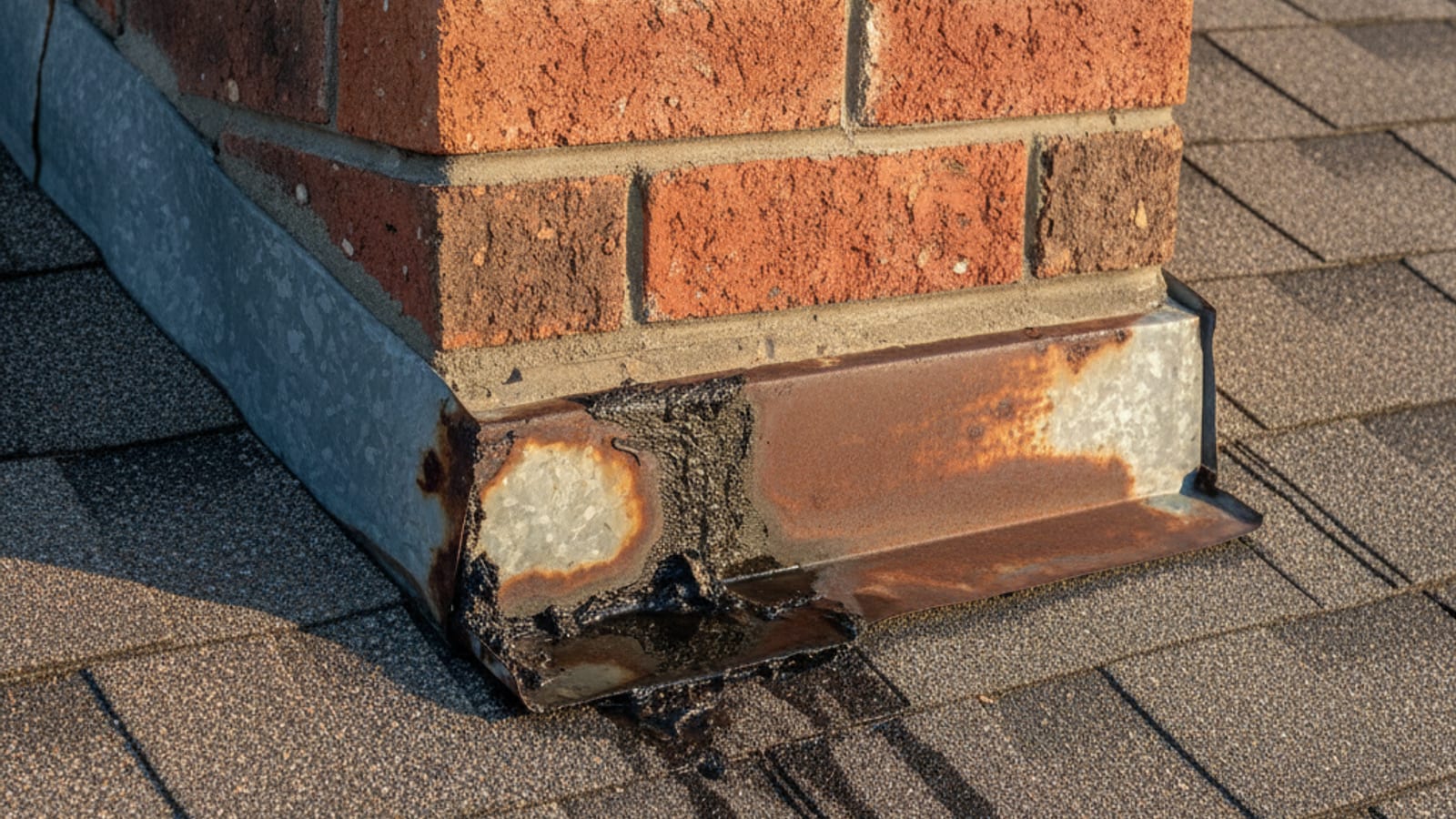
Chimney leak repair in San Diego County costs between $150 for a sealant fix and $2,400 for a crown rebuild. The right number depends on where the water actually gets in. Most leaks trace to one of four sources: failed flashing, a cracked crown, a missing cap, or porous brick. Find the wrong one and the leak doesn’t stop. Here’s how San Diego leaks behave and what each fix costs.
Why San Diego chimney leaks hide for months
Most of the country finds chimney leaks during winter storms. San Diego doesn’t work that way. We get a long dry stretch, then a few concentrated rain events between December and March. A leak that started last spring can sit silent until the first real storm.
That delay matters. By the time you see a stain, water has often been tracking through the masonry for months. Coastal homes get a second problem on top of that. The marine layer keeps brick and mortar damp overnight even when it doesn’t rain. Slow, repeated wetting breaks down crowns and mortar joints faster than the rain totals alone would suggest.
So a San Diego chimney can look bone-dry in October and leak on the first December storm. The fix gets cheaper the earlier you catch it. A $200 crown seal today beats a $2,000 masonry rebuild after two more rainy seasons.
The four sources, in order of how common they are
A real diagnosis figures out which one (or which combination) is letting water in. Then the pros we send fix that one. We don’t recommend fixing all four “just in case.” That’s expensive and unnecessary.
- Flashing failure at the roof line. The most common source, roughly 60% of leak calls. The metal that seals the chimney-to-roof junction rusts, lifts, or was caulked instead of properly installed.
- Crown failure at the top. The concrete or mortar slab cracks and water runs down through the masonry. Common in San Diego because the marine layer keeps crowns damp.
- Cap missing or failed. Rain falls straight down the flue. Easy to spot, easy to fix.
- Porous brick or failed mortar joints. Water soaks through the face during a heavy storm. The rarest of the four here, but real on older inland homes.
If a contractor quotes you a fix without telling you which of these four they found, get a second opinion. For a deeper symptom-by-symptom breakdown, read our guide on telling flashing leaks from crown leaks.
How the leak gets diagnosed: the hose test
The diagnostic technique is a controlled hose test. We isolate each suspect area in turn, run water on it, and watch for the leak inside. It takes 60 to 90 minutes done right.
Step 1: the brick face. Low-pressure water on the lower brick for 10 minutes. Water inside means porous brick or failed mortar.
Step 2: the flashing. Hose the chimney-to-roof junction for 10 minutes. Water now points to flashing.
Step 3: the crown. Hose just the top slab for 10 minutes. Water now means the crown is the source.
Step 4: the cap. No cap, or compromised mesh, means rain is falling directly into the flue.
National repair guides skip this step and jump straight to “reseal the flashing.” That’s why people pay twice. Don’t approve a repair without a diagnosis that names the source.
What each leak repair costs in San Diego County
These are 2026 ranges for San Diego County. They run higher than the national averages you’ll see on cost-comparison sites because coastal labor and proper materials cost more here, and shortcut fixes fail fast in this climate.
| Repair | San Diego cost | When it’s the right fix |
|---|---|---|
| Sealant / spot fix | $150–$500 | Minor caulk or small joint failure caught early |
| Cap install (stainless single-flue) | $225–$750 | Rain falling down an open or rusted flue |
| Crown seal (elastomeric) | $400–$700 | Hairline crown cracks, structure still sound |
| Flashing replacement | $450–$1,400 | Rusted or lifted flashing; high end includes a cricket |
| Masonry waterproofing (siloxane) | $650–$1,200 | Porous brick after other sources are ruled out |
| Crown rebuild | $950–$2,400 | Cracked-through crown, missing chunks, bad pour |
For the full pricing picture across every chimney repair type, see our San Diego chimney repair cost guide.
A note on the cheap fixes. A $150 sealant job is the right call only when the source is genuinely small and caught early. The mistake is sealing a leak that’s actually a cracked crown. The caulk holds for a season, then the real problem comes back bigger. Match the fix to the source.
Gas fireplaces still leak, and still need a cap
Plenty of San Diego homes run gas log sets, not wood. People assume an unused or gas-only chimney can’t leak. It can. The flue is still open to the sky. Rain still falls in. The crown still cracks.
Two things to know. First, a gas-only flue still needs a cap with screen, both to keep rain out and to keep animals from nesting in a flue that rarely sees heat. Second, gas combustion produces water vapor. In a poorly sized or uninsulated flue, that vapor condenses on the cold masonry and runs back down, which looks exactly like a rain leak but happens on dry days. If your “leak” shows up when you run the fireplace and not when it rains, condensation is the likely cause, and flue sizing is the fix.
The wildfire angle: your cap is doing two jobs
In San Diego County, the cap that keeps rain out is the same part that keeps embers from going up the flue and out, and keeps wind-blown embers from coming down in. Much of inland San Diego sits in a Wildland-Urban Interface zone where California code requires spark-arrester mesh on chimneys serving solid fuel.
If you’re already paying to fix a leak by installing or replacing a cap, get one with code-compliant spark-arrester mesh. You solve the water problem and the ember problem in one part. Ask any company whether their standard cap meets the mesh requirement for your zone.
What to ask before you approve any leak repair
The Chimney Safety Institute of America and NFPA 211 recommend a yearly inspection for every chimney, including gas. When you call about a leak, ask the company a few things:
- Did you run a hose test or just look? A visual guess isn’t a diagnosis.
- Which of the four sources is it? They should name one, with a photo from the roof.
- Is this the permanent fix or a seasonal patch? A $150 reseal on a failing crown is a patch.
- Does your cap meet spark-arrester code for my zone? Relevant across most of inland SD County.
- Is the inspection fee credited toward repairs? Many honest companies credit it. Ask.
We give upfront written quotes, we cover all of San Diego County, and we know how low-use coastal chimneys actually fail. We tell you the source before we quote the fix.
FAQ
How much does chimney leak repair cost in San Diego? Between $150 for a small sealant fix and $2,400 for a full crown rebuild. Most leaks land in the $450 to $1,400 range for flashing or crown work. The cost depends entirely on which of the four sources is letting water in.
Why is my chimney leaking when it barely rains in San Diego? Two reasons. Leaks that started months ago often stay hidden until the first real storm reveals the stain. And the coastal marine layer keeps masonry damp overnight, which can produce moisture inside even on dry days, especially condensation in gas flues.
Can a chimney leak if I only have a gas fireplace? Yes. The flue is still open to rain, the crown still cracks, and gas combustion creates water vapor that can condense inside an uninsulated flue. A gas-only chimney still needs a cap and an annual inspection.
How do I know if it’s the flashing or the crown? A controlled hose test isolates each source. Flashing leaks usually stain the ceiling along the roofline and worsen in driving rain. Crown leaks show up as water on the smoke shelf and staining on the upper brick. Our flashing vs. crown guide walks through the signatures.
Should I just seal the chimney to stop the leak? Only if the actual source is small and caught early. Sealing over a cracked crown or failed flashing hides the problem for a season, then it returns worse. Get the source diagnosed first, then match the fix to it.
How often should I have my chimney inspected in San Diego? Once a year, per CSIA and NFPA 211, even for gas and even for chimneys you rarely use. Catching a hairline crown crack early is the difference between a $400 seal and a $2,400 rebuild.
Bottom line
San Diego chimney leaks hide longer than they do anywhere with regular winter storms, and the coastal marine layer wears down crowns and mortar even on dry days. The fix is cheap when you catch it early and expensive when you don’t. Get the source diagnosed before you approve any repair, and don’t let a $150 patch stand in for the $400 fix your chimney actually needs.
Want a straight answer on where your chimney leaks and what it’ll cost to stop it? Call us at (858) 925-5546 for an upfront quote anywhere in San Diego County. Start with our chimney leak diagnosis service and we’ll tell you the source before we tell you the price.