Water stains on the ceiling next to the chimney, water on the smoke shelf, wet brick after a storm. Chimney leaks are common. The diagnosis is harder than people think, because chimney leaks come from one of four different sources, and the fix for each is different. Pay for the wrong fix and the leak doesn’t stop.
Here’s how to figure out which one you have.
The four sources of chimney leaks
Roughly in order of how common they are:
- Flashing failure at the roof line (most common, about 60% of leak calls)
- Crown failure at the top of the chimney
- Cap missing or failed (rain falling directly into the flue)
- Porous brick face soaking up moisture during heavy rain
A leak diagnosis figures out which one (or which combination) is the actual source. Then the pros we send fix that one. We don’t recommend fixing all four “just in case”, that’s expensive and unnecessary.
How we diagnose: the hose test
The diagnostic technique is a controlled hose test. We isolate each suspect area in turn, run water on it, and watch for the leak inside.
Step 1: Test the brick face. Run a garden hose at low pressure on just the lower brick face for 10 minutes. Watch the interior. If you see water inside, the brick is porous (or the mortar joints are failing) and water is soaking through.
Step 2: Test the flashing. Hose the flashing junction where the chimney meets the roof for 10 minutes. Watch the interior. If you see water now, it’s flashing.
Step 3: Test the crown. Hose just the top of the chimney crown for 10 minutes. Watch the interior. If you see water now, the crown is letting water down through the masonry.
Step 4: Check the cap. If there’s no cap (or the cap mesh and roof are completely uncompromised), water is falling directly into the flue.
A real leak diagnosis takes 60–90 minutes. We do it as part of the $89 inspection, and if you’ve been told “your chimney leaks, you need a $4,000 reline” without a hose test, get a second opinion.
Symptoms that point to flashing
Flashing leaks have a specific signature:
- Water stains on the ceiling at the line where the chimney passes through the roof (often follows the slope of the roof)
- Wall stains in the attic where the chimney passes through
- Stains worse during driving rain with horizontal wind component
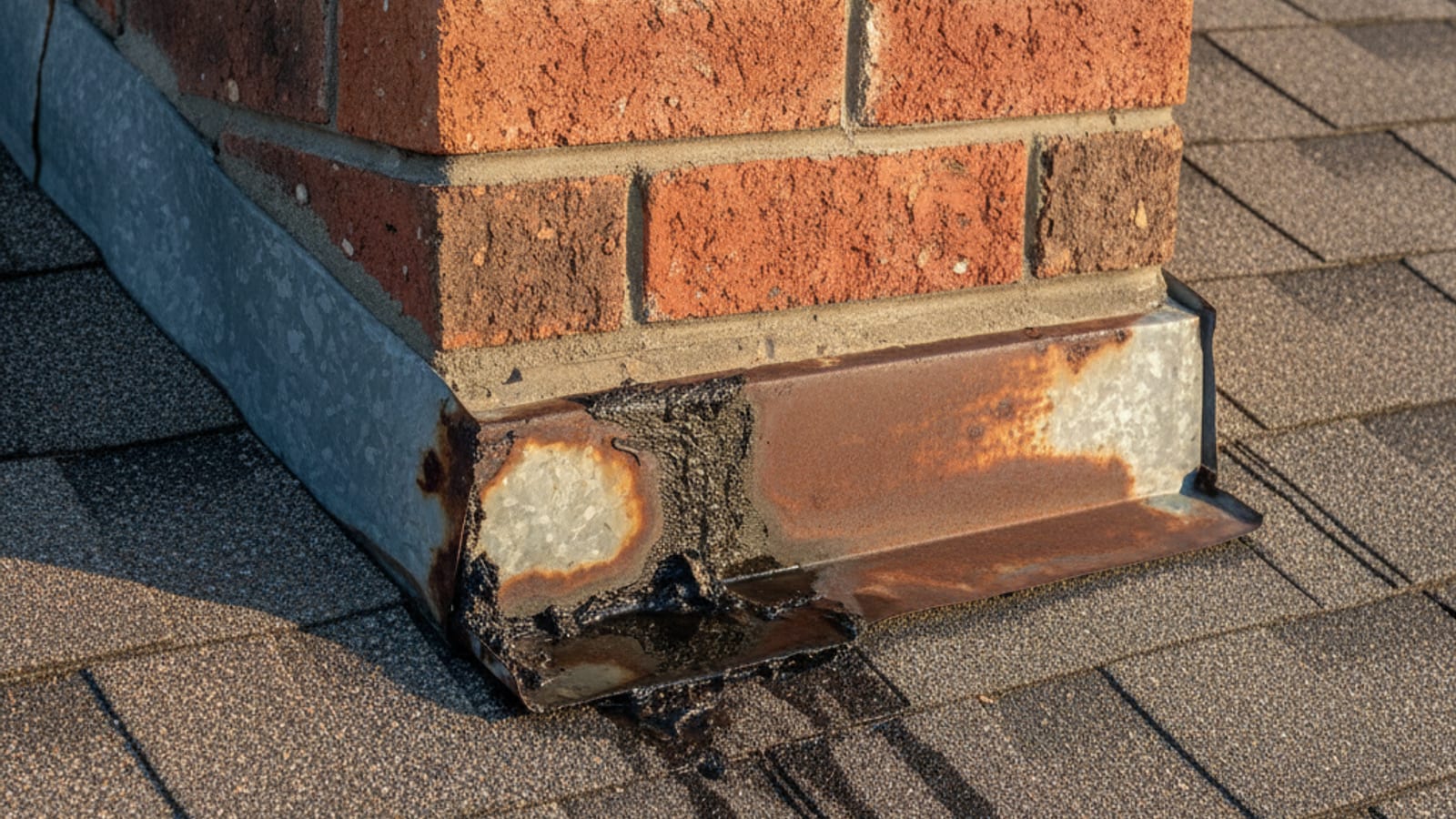
- Visible rust, gaps, or roofing tar lumps around the chimney base on the roof
- Chimney was reflashed during a recent reroof (most common cause, sloppy roofer flashing work)
Why flashing fails:
- Galvanized flashing rusts through (most common, 20-year typical life on coastal galvanized)
- L-flashing wrapped up the brick and sealed with caulk, caulk dries, fails, water tracks down behind
- Missing or improperly installed counter flashing
- No cricket on chimneys wider than 30” (water dams on the upslope side)
Fix: strip and replace step + counter flashing with proper saw-cut reglet for the counter flashing. Aluminum or copper, sealed with lifetime polymer (NovaFlash or similar). $450–$900 typical, or $800–$1,400 if cricket fabrication is needed.
Symptoms that point to crown
Crown leaks signature:
- Water on the smoke shelf after rain (water tracked down through the masonry from above)
- Water staining on the upper bricks (vertical streaks on the upper third of the chimney)
- White efflorescence on the brick face (water moving through the masonry, depositing salts)
- Spalled brick faces in the upper third (popped-off brick face from freeze-thaw)
- Crown is visibly cracked when viewed from a roof (or from binoculars on the ground)
Why crowns fail:
- Mortar wash crown (pre-1990 standard) cracks in 10–15 years
- Concrete crown poured flush with brick (no overhang), water sits on the brick
- Concrete crown poured directly on flue tile (no bond break), flue expansion cracks the crown
- General age, even good crowns reach end-of-life around 30 years
Fix:
- Hairline cracks, intact structure: CrownCoat seal, $400–$700
- Structural cracks, missing chunks, design flaws: full rebuild, $950–$2,400
Symptoms that point to cap (or no cap)
Cap leaks signature:
- Water in the firebox after rain (rain falls down the flue directly)
- Wet ash in the firebox after a storm
- Animal sounds or smells from the chimney (uncapped flue is also unscreened)
- Visible rust streaks down the brick from the cap area (failing galvanized cap dripping rust)
Fix: install a proper cap, stainless steel single-flue starts at $225 installed. Lifetime warranty.
Symptoms that point to porous brick face
Porous brick is the rarest of the four. Symptoms:
- Wet brick during heavy rain that dries quickly afterward
- No clear water entry point when other tests come up negative
- Old brick (pre-1950) with deteriorated face
- Damaged brick from previous spalling that wasn’t repaired
Fix: siloxane masonry sealer application. Pump-sprayed onto the masonry, penetrates the brick to make it water-repellent without sealing in moisture. $650–$1,200 depending on chimney size. Lasts 7–10 years.
This is also where tuckpointing matters, failing mortar joints let water in even if the brick faces are sound. Tuckpointing first, sealer second when both are needed.
Why the diagnosis matters
Chimney leak repairs range from $225 (new cap) to $2,400 (full crown rebuild) to $1,400 (flashing with cricket) to $1,200 (tuckpointing + sealer). Picking the wrong one means paying for it twice.
Common diagnostic mistakes we see:
“It must be the flashing because that’s where roofers blame everything.” Sometimes. Often it’s actually the crown, and the roofer flashed it correctly during reroof. Hose test confirms.
“It must be the crown because the brick is wet.” Sometimes. Often the brick is wet from flashing failure, the water tracks across the upper masonry from the failed flashing junction. Hose test isolates.
“It must be the cap because there’s water in the firebox.” Maybe. Could also be water from a failed crown tracking down through the smoke chamber and dripping into the firebox. Hose test isolates.
Don’t approve a repair without a leak diagnosis. The $89 inspection plus 30 minutes of hose testing will tell you which fix you actually need.
Bottom line
- Most chimney leaks are flashing leaks (~60% of calls). Symptoms: ceiling stains at the chimney line, attic stains, worse in driving rain.
- Crown leaks are second most common. Symptoms: water on smoke shelf, upper brick staining, efflorescence.
- Cap leaks are obvious, water in the firebox. Easy fix.
- Porous brick is rare. Diagnosis only after other sources are ruled out.
Get the diagnosis first. We do hose tests and camera scans during the $89 inspection, the fee is credited toward any repair work that follows.
Call us at (858) 925-5546.