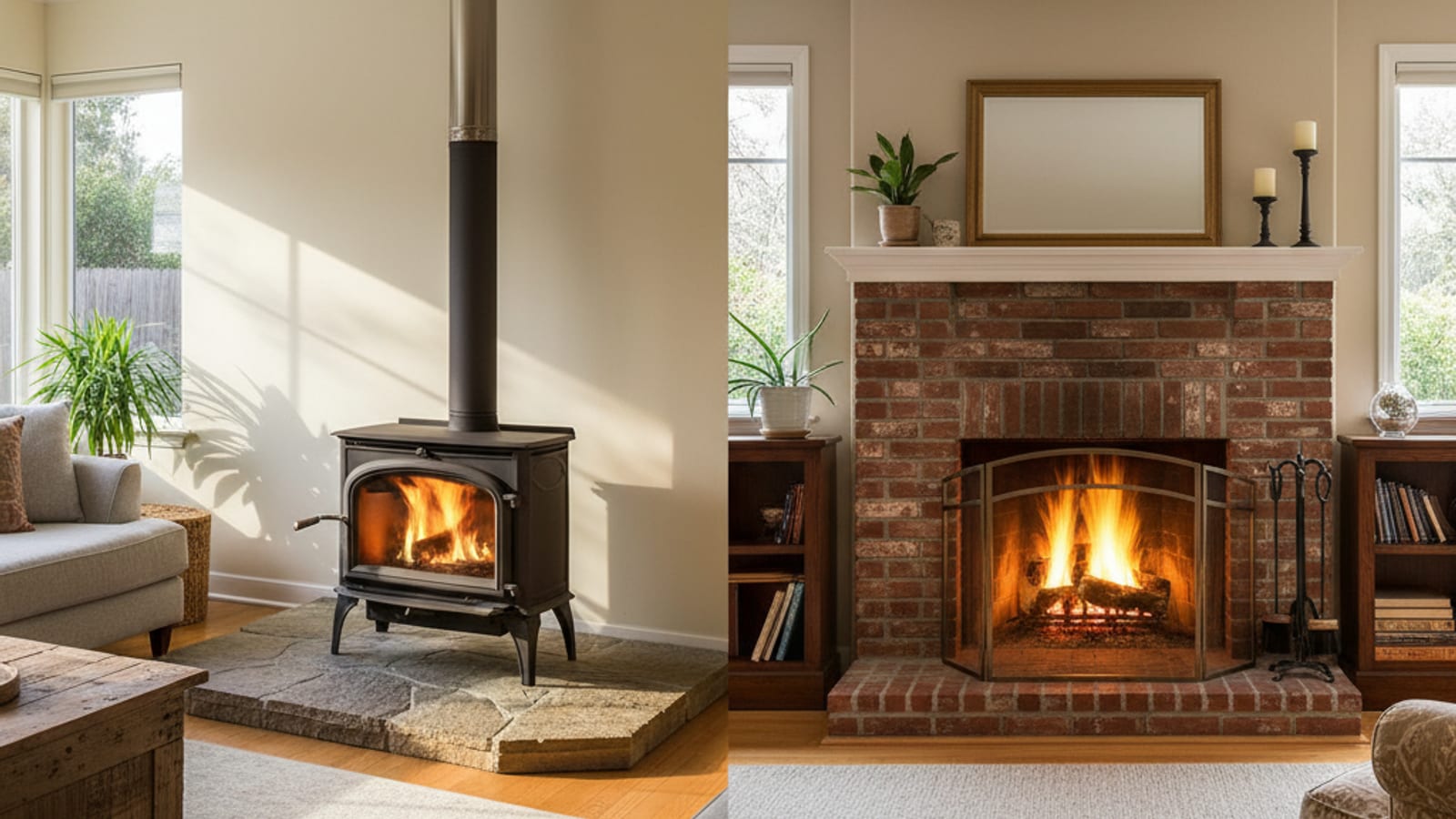
If you’re using your fireplace for heat, the math may surprise you. A traditional open masonry fireplace converts about 10–20% of the wood’s energy into useful indoor heat. A modern EPA Phase 3 wood stove insert converts 70–80%. That’s the difference between losing money to the chimney and actually heating the house.
Here’s an honest comparison for San Diego homes.
How an open fireplace actually performs
An open masonry fireplace looks like it should heat well. Big firebox, lots of fire, radiant heat into the room. But the physics work against it:
- Most heat goes up the chimney, not into the room. The fire heats the air, the air rises, you lose it.
- The damper has to be wide open during the fire, which also lets in cold air down through the rest of the house (think of the chimney as a giant straw pulling air out of your living room).
- After the fire dies, the open damper continues losing heat until you remember to close it (and then you can’t close it until the embers are completely cold without smoke spillage).
- Net efficiency: 10–20%. A good number to remember: an open fireplace running on a cold San Diego night may actually make the rest of the house colder than if you didn’t light it at all.
The honest use case: open fireplaces are atmospheric heating. They make the room around them feel warm and create a beautiful focal point, but they’re not a heating appliance.
How a modern wood stove insert performs
A wood stove insert is a sealed metal firebox that fits inside your existing masonry fireplace. The stove is sealed (door gasket), uses controlled combustion (you control the air intake), and runs an insulated stainless liner up the chimney.
- Sealed combustion means no room air goes up the chimney, only the air that goes through the controlled intake.
- Insulated liner keeps flue temperatures higher, which means more complete combustion and dramatically less creosote.
- Catalytic combustor (cat models) re-burns the wood gas at lower temperatures for higher efficiency.
- Net efficiency: 70–80% for EPA Phase 3 stoves. Some hyper-efficient models hit 85%.
The honest use case: a wood stove insert can be primary or supplemental heat for the rooms within radiant range. With proper sizing, a single stove can heat 1,200–2,000 square feet effectively.
Cost comparison over 10 years
Numbers for a typical San Diego household burning 1.5 cords/year:
Open fireplace:
- Equipment: $0 (existing)
- Annual sweep: $189 × 10 = $1,890
- Wood: 1.5 cords × $400 × 10 = $6,000
- Net heat delivered: ~15% of wood energy = roughly equivalent to running a small space heater 4 hours/day
- 10-year cost: $7,890
- Heat value: minimal (atmospheric only)
Wood stove insert (mid-range EPA Phase 3):
- Equipment + insulated stainless liner installed: $4,500–$6,500
- Annual stove service + sweep: $269 × 10 = $2,690
- Wood: 1.5 cords × $400 × 10 = $6,000 (same wood, much more usable heat)
- Catalyst replacement at year 7: $400
- Net heat delivered: ~75% of wood energy = roughly equivalent to a 25,000 Btu wall heater running through winter evenings
- 10-year cost: $13,590 (or $7,090 above the open fireplace)
- Heat value: substantial (real supplemental or primary heat for surrounding rooms)
The ROI math depends on what you’re replacing. If the stove insert displaces electric or propane heat in your living space, payback can be 5–8 years. If it’s purely atmospheric (you’d otherwise heat the same way), the math is harder.
When each one makes sense
Open fireplace makes sense when:
- You light fires for ambiance, not heat
- You burn fewer than 10 fires per year
- The fireplace is in a room you don’t try to heat with it
- You want the visual and don’t care about efficiency
- You’re not interested in the maintenance of a stove (gasket replacement, catalyst service)
Wood stove insert makes sense when:
- You want the fireplace to actually heat the room or the house
- You burn through November to March consistently
- You live in East County, North County Inland, or Backcountry where heating loads are real
- Your electric or propane heating bills are high
- You have a reliable wood supply (own land, established cord supply)
Wood stove insert is the wrong answer when:
- You only burn occasionally for ambiance
- You don’t want to deal with the maintenance (annual stove service is essential)
- The stove would face a wall instead of the room (radiant heat is directional)
- The chimney is in poor structural condition (insert installation requires good liner work)
San Diego County considerations
Coastal zones (Coronado, Del Mar, Encinitas): Open fireplaces are typical. Heating loads are mild enough that the efficiency loss doesn’t matter much. Most coastal fireplaces stay open.
North County Inland and East County: The crossover zone. Many homes here have real winter heating needs (December–February evenings drop into the 30s and 40s). A wood stove insert can meaningfully reduce heating bills, especially for homes on propane.
Backcountry (Julian, Pine Valley, Mount Laguna): Wood stove inserts are often primary or sole heat. EPA Phase 3 stoves with catalytic combustors are the standard. Most cabins burn 2–4 cords per season, a properly sized stove handles it.
Conversion realities
Converting an open fireplace to a wood stove insert involves:
- CSIA Level 2 inspection to verify the chimney is sound and properly sized for an insert
- Insulated stainless steel liner installed from the stove up to the cap (mandatory for any insert installation)
- Stove selection based on firebox size, square footage to heat, and aesthetic preference
- Hearth modifications if the existing hearth doesn’t meet clearance requirements for the insert
- Permit and inspection if required by your AHJ
- Annual service going forward, $269/year for stove cleaning, gasket inspection, and liner check
Total install: $4,500–$6,500 for a quality EPA Phase 3 insert with proper liner. Premium catalytic stoves (Blaze King, Woodstock) run higher.
What about gas log sets?
Worth mentioning: a vented gas log set installed in the existing masonry fireplace is also an option. Aesthetically similar to wood, no creosote, instant on/off, slightly better efficiency than open wood-burning (still well below stove inserts).
Cost: gas log set + installation + properly sized aluminum liner: $1,200–$2,500.
Right answer for: homeowners who want the look of a fire without the work of wood, and who already have a gas line nearby.
Wrong answer for: anyone trying to actually heat the home (vented gas log sets are still mostly atmospheric).
Bottom line
- Open fireplace: atmospheric only. ~15% efficient. Right for occasional ambiance.
- Wood stove insert: real heat. ~75% efficient. Right for regular winter use and inland/backcountry homes.
- Vented gas log set: convenience over heat. Right for low-maintenance fireplace use.
If you’re considering an insert installation, schedule a Level 2 inspection first. We assess the chimney structure and flue sizing, then quote the install (insert + liner + permits) as a complete package.
Call us at (858) 925-5546.