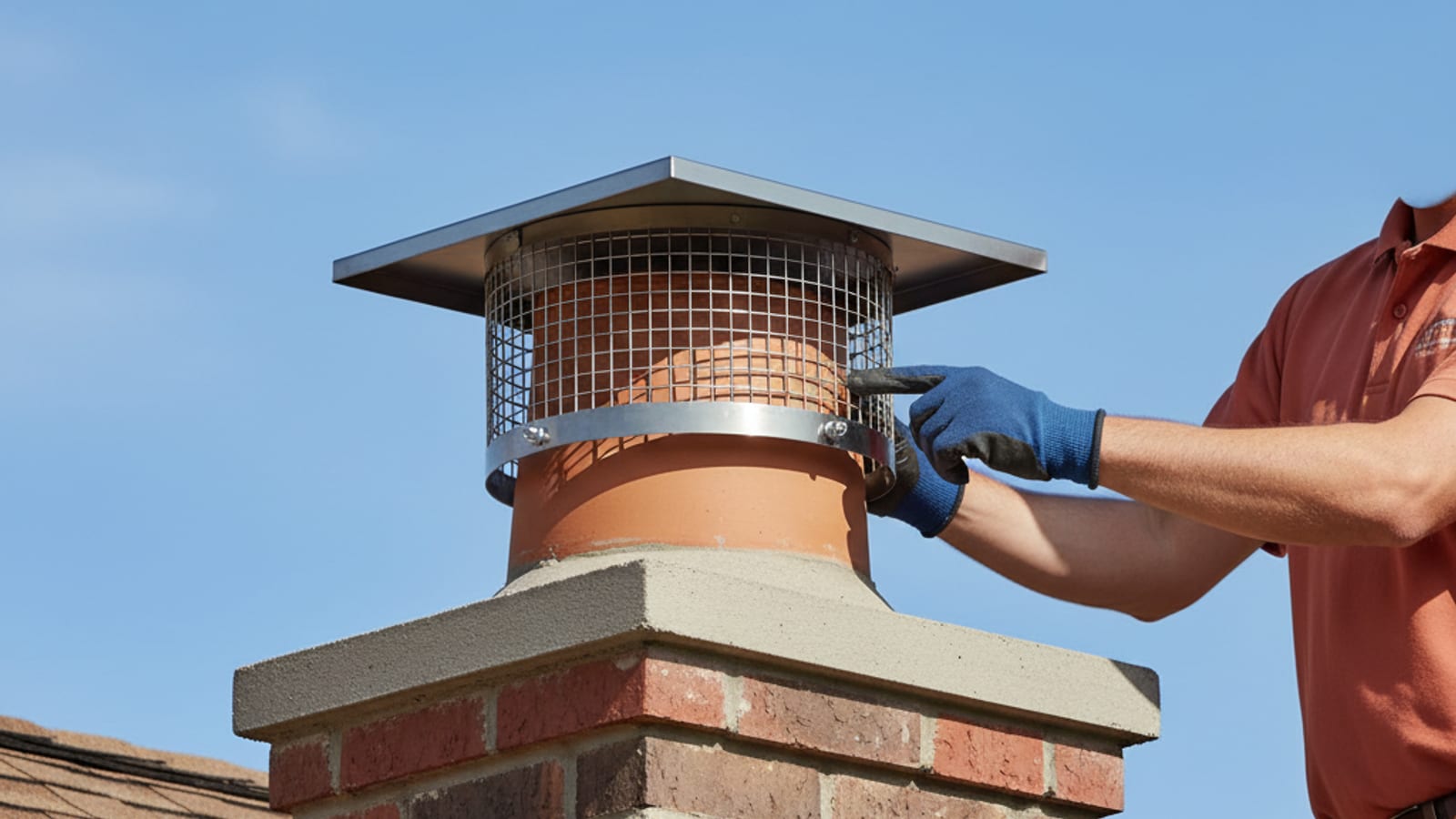
A chimney cap is the cheapest insurance you can buy for a chimney. It blocks rain, animals, downdrafts, and embers, and on most San Diego chimneys, the spark arrester mesh on the cap is required by California fire code.
But cap quality varies wildly. Here’s how to choose one that lasts and meets the code.
What a chimney cap actually does
Four jobs:
Blocks rainwater from entering the flue. A flue without a cap collects water during every rain, which damages the masonry, accelerates creosote breakdown into damaging acids, and rusts metal liners. A cap is the first line of defense against water damage.
Blocks animals. Birds, raccoons, bats, and squirrels love uncapped flues. Nests block draft (smoke spillage), trap creosote, and themselves catch fire fast. Animal damage is one of the most common reasons we get called for emergency service.
Blocks downdrafts and improves draft. Wind-baffle (windcap) designs use the wind to actually pull air up the flue instead of pushing it down. Helps short chimneys and chimneys near tall trees or roof peaks.
Stops sparks and embers from escaping. This is the spark arrester function, and in California fire severity zones, this is mandatory.
The spark arrester rule (California Building Code)
California Building Code requires spark arrester mesh on any chimney serving solid fuel in a Wildland-Urban Interface (WUI) zone. Most of inland San Diego County qualifies.
Spec:
- 12-gauge or heavier wire mesh
- 3/8 inch minimum opening, 1/2 inch maximum opening
- Covers the entire perimeter of the cap (no gaps)
CalFire enforces this. Insurance carriers also increasingly require documented spark arrester compliance. Some now require recent CSIA Level 2 inspection on file as a condition of coverage.
If your existing cap doesn’t meet the spec, or if you have no cap at all, that’s a code violation if you’re in the WUI. All our caps meet the code by default.
Cap materials: which one to choose
Four common materials, ranked by service life:
Galvanized steel: $25–$60, 5–10 year life
The cheap default at most home centers. Painted galvanized or zinc-plated steel. Looks fine on day one. Rusts through in 5–8 years near the coast (Coronado, Del Mar, Imperial Beach), 10 years inland.
We don’t install galvanized caps. The labor cost is the same as a stainless install, but you’re back replacing it in 5–10 years. The math doesn’t work.
Painted aluminum: $80–$150, 10–15 year life
Better than galvanized. Won’t rust through, but the paint chips and the bare aluminum oxidizes. Fasteners are the weak point, galvanized fasteners on aluminum bodies fail first.
Acceptable for inland zones if budget is tight. Not recommended for coastal exposure.
Stainless steel: $200–$400 installed, lifetime
The right default for San Diego County. 304 stainless for most installations; 316 stainless for direct coastal exposure (within 1 mile of the ocean). Won’t rust through, won’t oxidize, fasteners stay sound. Lifetime warranty against rust-through is standard.
This is what the pros we send install on most jobs. Pricing: $225 single-flue installed, $450–$650 multi-flue installed.
Copper: $600–$1,200 installed, 50+ year life
Premium choice. Develops a beautiful patina over 5–10 years. Extreme service life. Used on historic restorations, custom homes, and clients who want a feature element on the chimney.
Pricing: 3x stainless cost. Worth it if you’re staying in the home long-term and want the visual.
Single-flue, multi-flue, and chase covers
Three different products for three different chimney configurations:
Single-flue cap
One cap per flue. Mounts to the clay flue tile (or to the metal liner if relined). Standard for most masonry chimneys with a single fireplace.
Pricing: $225 stainless installed.
Multi-flue cap
One cap covering multiple flues on a shared crown. Common on older chimneys that vent both a fireplace and a furnace. Looks cleaner from the curb than two single caps but requires precise crown measurement.
Pricing: $450–$650 stainless installed.
Chase cover (for prefab chimneys)
Prefab chimneys (the metal-chase ones) don’t have a poured crown, they have a chase cover, which is the entire top of the chase. When the original galvanized chase cover rusts through (typically 8–10 years), water gets into the chase and damages the prefab firebox. Replacement requires a custom-cut stainless cover with proper slope.
Pricing: $750+ installed, depending on chase dimensions.
Wind-baffle and downdraft caps
Standard caps stop rain and animals. Wind-baffle caps also improve draft on chimneys with downdraft problems.
Common downdraft causes:
- Chimney shorter than nearby trees or roof peaks
- Negative pressure inside the home (tight modern construction, exhaust fans running)
- Coastal canyon wind funneling
- Chimney too narrow for the appliance
A wind-baffle cap (Vacu-Stack, Energy Top, similar) uses Bernoulli’s principle, wind blowing across the cap creates suction that pulls air up the flue. Costs about $120–$180 more than a standard cap.
Wind-baffle caps don’t fix every downdraft problem. If the issue is a too-large flue or stack-effect inside the home, the cap alone won’t solve it. We diagnose first, recommend the right product second.
Animal exclusion considerations
If you’ve had animal problems, the cap mesh size matters:
- 3/8 inch mesh: blocks raccoons, squirrels, large birds, bats
- 1/2 inch mesh (the spark arrester maximum): blocks raccoons and squirrels but lets small birds (chimney swifts) and bats through
- 1/4 inch mesh (smaller than spark arrester spec): blocks everything but doesn’t meet code
For most San Diego homes the 3/8” spark-arrester mesh is the sweet spot, meets code and keeps animals out.
How to size a cap
For DIY measurement before calling:
- Climb to the roof safely. Bring a tape measure.
- Measure the outside dimensions of the flue tile (or the chase opening for prefab).
- Measure the height you want the cap to clear above the flue (typically 6–10 inches).
- Note whether the chimney is single-flue, multi-flue, or prefab chase.
For most installations we measure during the inspection visit, saves you the climb.
Bottom line
- Stainless single-flue cap: $225 installed. Right answer for most San Diego homes.
- Stainless multi-flue cap: $450–$650 installed. For chimneys with two or three flues sharing a crown.
- Custom stainless chase cover: $750+ installed. For prefab metal-chase chimneys.
- Add a wind-baffle option ($120–$180): if you have downdraft issues.
- Spark arrester mesh is mandatory in most of inland San Diego County. All our caps meet the code.
If your current cap is rusted, missing mesh, or absent entirely, schedule a cap install. It’s a single-visit job and the cheapest insurance you can buy for the chimney.
Call us at (858) 925-5546.