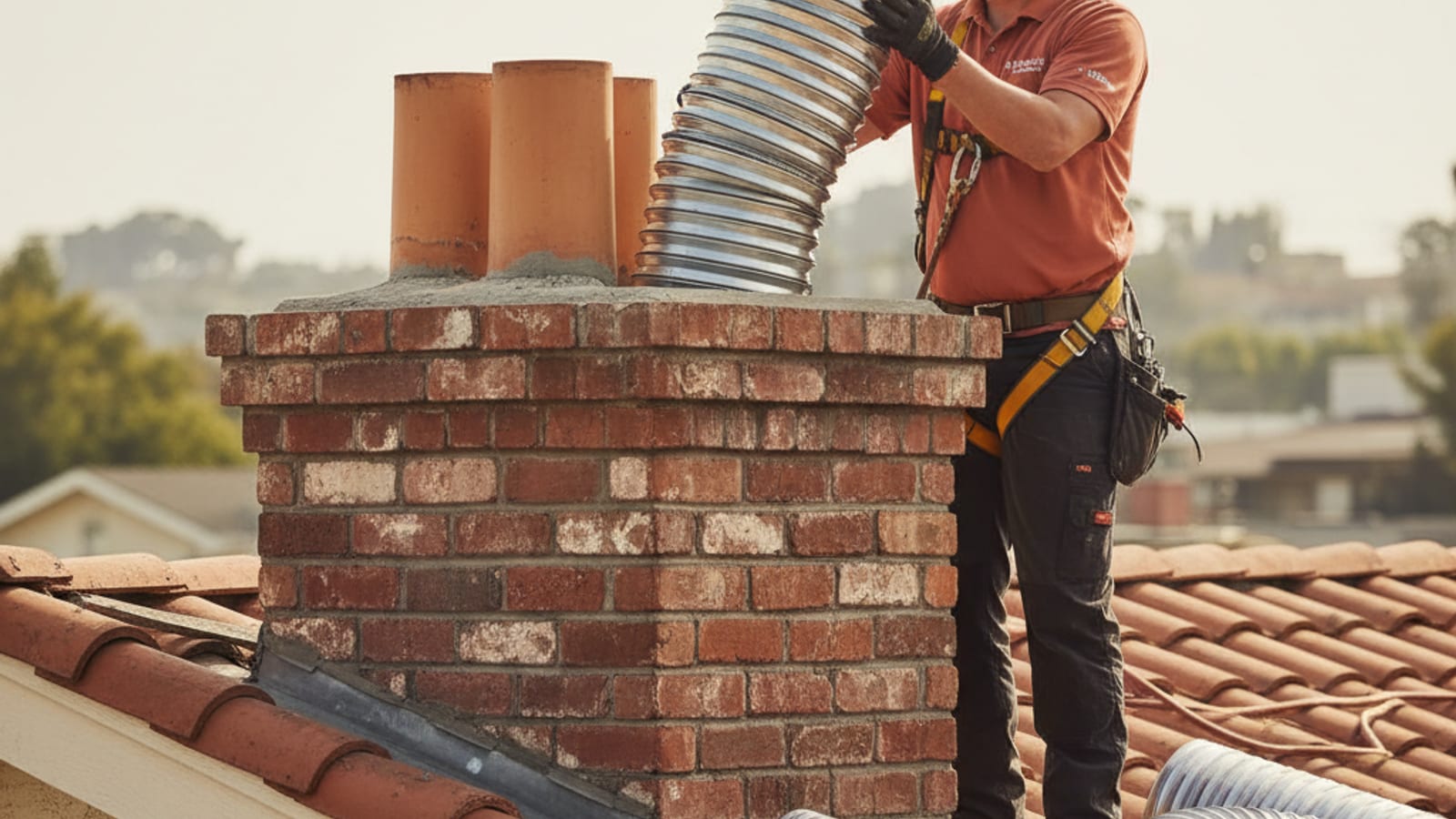
The flue liner is what protects the masonry from combustion gases and contains those gases inside the flue. When the original clay tile cracks, when you switch fuels, or when you install a new appliance, you may need a new liner. The right product depends on what’s burning and how the existing flue looks.
Here’s how to choose.
Three liner products to know
Aluminum liner. Lightweight flexible aluminum tubing. Limited to low-Btu Category I gas appliances, typical residential gas furnaces and water heaters. Cheaper than stainless. Service life 10–15 years.
Stainless steel liner. Heavy-gauge flexible or rigid stainless tubing. Required for any solid-fuel appliance (wood stove, fireplace insert, pellet stove), oil, or high-efficiency gas. Comes with insulation wrap for solid fuel installations. Lifetime warranty on quality products. Service life 25–40 years real-world.
HeatShield ceramic repair. Not a full liner, a cementitious system applied with a foam plug pulled up the flue to repair small joint gaps and minor cracks in otherwise sound clay tile. Adequate when the existing tile is mostly intact. Roughly half the cost of a stainless reline.
When you need each one
Aluminum liner
Right answer for:
- Replacement of an existing clay-tile flue serving a Category I gas furnace
- New high-efficiency gas water heater (when the existing flue is too large for proper draft)
- Decommissioned wood fireplace converted to vented gas log set (low-Btu only)
Wrong answer for:
- Any solid fuel
- High-efficiency furnaces over 90% AFUE (use stainless)
- Oil appliances
- Wood stove inserts of any kind
Pricing: $1,200–$1,800 for a standard 25-foot run.
Stainless steel liner
Right answer for:
- Wood stove or fireplace insert installation (mandatory)
- Pellet stove installation
- Oil-fired appliance venting
- High-efficiency (90%+ AFUE) gas furnace
- Reline of cracked or missing clay flue tile sections
- Any installation that needs a 25+ year liner
Always insulated for solid-fuel installations. Insulation wrap keeps flue gases hot enough to prevent condensation, which is what eats clay tile from the inside.
Pricing: $2,400–$4,500 for a standard 25-foot run with insulation. Premium rigid liners and complex installations run higher.
HeatShield ceramic repair
Right answer for:
- Minor cracks in flue tile (hairline, no missing sections)
- Failed mortar joints between flue tile sections
- Small gaps in the smoke chamber masonry
- Repair of an otherwise sound clay flue at lower cost than stainless reline
Wrong answer for:
- Multiple cracked tiles
- Missing flue tile sections
- Wood stove insert installation
- Any structural flue damage
Pricing: $800–$1,800 depending on extent of repair.
Why aluminum vs. stainless matters
Two reasons aluminum is limited:
Heat tolerance. Aluminum melts at lower temperatures than the gases produced by solid fuel and high-efficiency gas appliances. Use the wrong material and the liner deforms or fails.
Acid resistance. Modern high-efficiency furnaces produce condensate that’s mildly acidic. Aluminum corrodes from acidic condensate within 2–5 years. Stainless steel doesn’t.
Code (NFPA 211, manufacturer install instructions) is specific about which appliances can use which liners. Don’t let a contractor install aluminum on something that requires stainless to “save you money”, you’ll be paying for both within a few years.
How to size a liner
Liner sizing depends on the appliance Btu input, the chimney height, and the appliance manufacturer’s spec.
General principle: oversized flues create draft problems for modern appliances. Old high-Btu wood-burning fireplaces had big flues because they needed them. Modern high-efficiency gas appliances have lower exhaust temperatures and need smaller flues to maintain proper draft. Putting a small modern appliance in a big old flue causes condensation, draft loss, and creosote-equivalent acidic deposits.
This is why many high-efficiency furnace installations require dropping a properly-sized aluminum or stainless liner inside the existing oversized clay flue. The new liner sizes the flue to the appliance.
We size during the inspection, we don’t guess.
When you need a Level 2 inspection first
You need a Level 2 inspection (camera scan) to determine which liner product is right:
- Switching fuels (wood to gas, gas to wood, gas to insert)
- After a chimney fire
- Adding a new gas appliance
- Camera scan or sweep flagged the existing flue tile as cracked
- Carbon monoxide alarm has gone off
- Inspector flagged the flue as undersized for the appliance
The Level 2 ($249) gives us the camera footage, the flue dimensions, and the structural assessment to recommend the right product.
Removing old tile vs. liner inside existing tile
Most stainless reline installations drop the new liner inside the existing clay tile. The clay tile stays in place, the liner runs down inside it, with insulation wrap filling the gap.
When that won’t work:
- Tiles are offset (won’t pass the liner through)
- Flue is too narrow for liner + insulation
- Multiple sections of tile are completely missing
- Tiles are loose and could fall on the liner
In those cases, the pros we send break out the clay tile from the top and install the liner direct to the masonry. Bigger job (an extra day on site), more expensive, but it’s required when the existing tile fails any of the above tests.
Common installation scenarios
Scenario: New high-efficiency gas furnace replaced an old standard-efficiency one.
Old furnace exhausted hot enough to keep the existing 8x8” clay flue working fine. New furnace exhausts cool, condensate forms inside the oversized flue, eats the masonry from the inside. Fix: drop a properly sized 4” or 5” stainless liner inside the existing clay tile. $2,800–$3,800.
Scenario: Wood stove insert installation in existing fireplace.
Mandatory: insulated stainless liner from the stove flue collar up to the chimney cap. The existing clay tile usually stays in place; the liner runs down inside it. $3,200–$4,500 depending on chimney height. Without the liner, the stove will not pass code inspection.
Scenario: Camera scan found two cracked tiles in a 25-foot flue.
Two options:
- HeatShield repair at the two crack locations: $1,200–$1,500
- Full stainless reline: $2,400–$3,800
HeatShield is cheaper short-term. Stainless is the lifetime fix. We recommend based on age of the chimney and how long you plan to stay in the home.
Scenario: Decommissioning a wood fireplace, installing vented gas logs.
Aluminum liner sized to the gas log set Btu input. $1,200–$1,800 including the vented gas log installation coordination.
Bottom line
- Aluminum liner = low-Btu Category I gas appliances only. $1,200–$1,800.
- Stainless steel liner = any solid fuel, oil, or high-efficiency gas. Lifetime fix. $2,400–$4,500.
- HeatShield ceramic repair = minor cracks in otherwise sound clay tile. Half the cost of stainless. $800–$1,800.
Get the Level 2 inspection ($249) before approving any liner work, the camera scan tells us what you actually need.
Call us at (858) 925-5546.