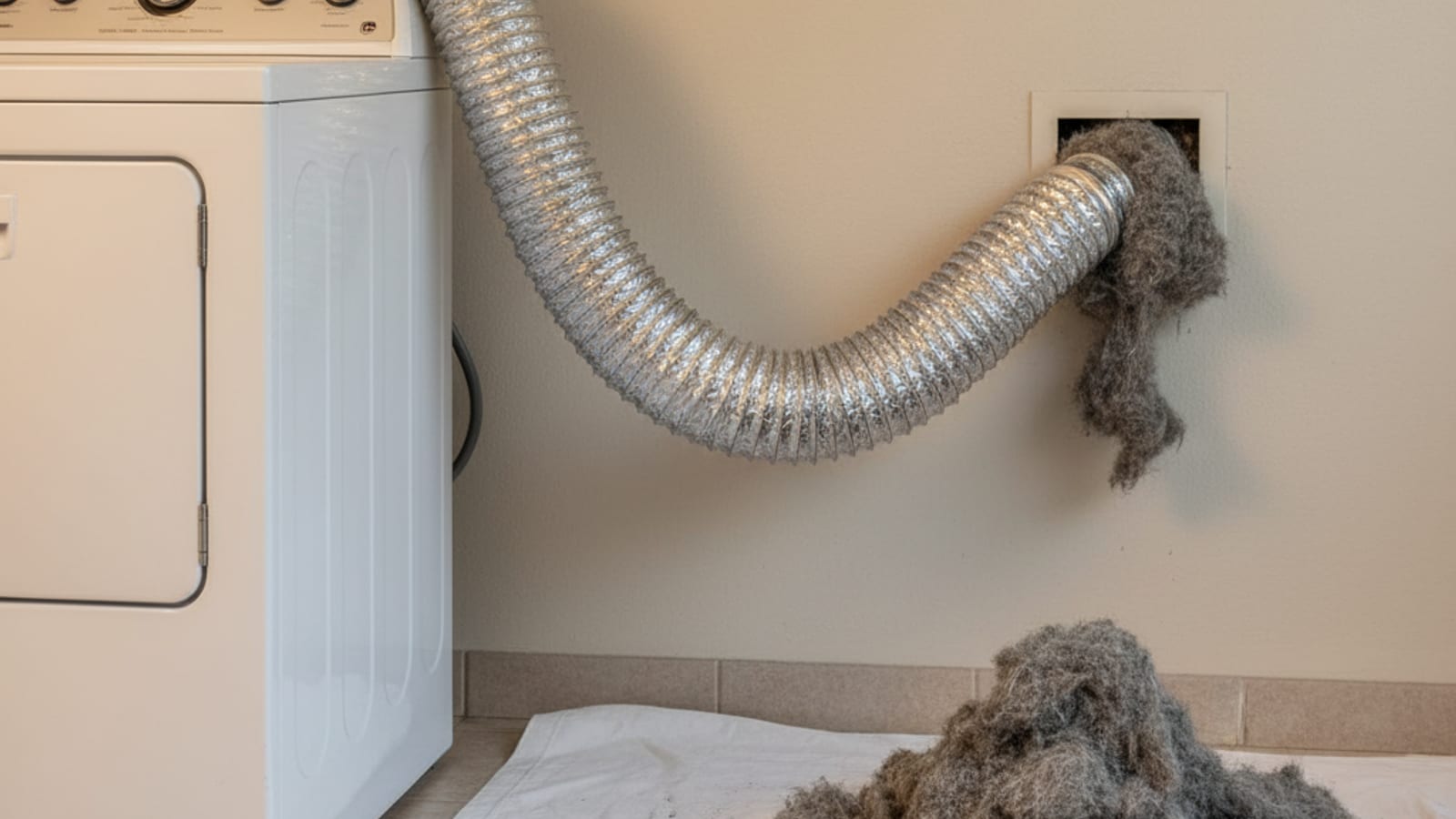
The U.S. Fire Administration estimates 2,900 dryer-related house fires every year, with the leading cause being failure to clean the vent. That’s not the lint trap, that’s the vent ductwork running from the dryer to the exterior wall hood. It’s also the part homeowners most often overlook.
Here’s why it happens and how to stop it from happening to you.
Why dryer vents catch fire
Two things have to be true for a dryer vent fire:
- Lint is accumulated in the vent. Lint is concentrated cellulose fiber, extremely flammable.
- The dryer is running hot enough to ignite it. Restricted airflow makes the heating element run continuously instead of cycling, which raises temperatures past safe limits.
Both conditions develop together. As lint builds up, airflow decreases. Decreased airflow means the dryer runs longer to dry the same load. Longer cycles mean more heat. More heat plus more accumulated lint = ignition.
The fire usually starts at the lint screen housing or at the first elbow in the vent run, where lint piles up most.
Warning signs your vent is at risk
Five signs your vent needs attention:
Dry times have crept past 60 minutes for a normal load. This is the most reliable signal. A clean-vented dryer dries a normal load in 35–45 minutes. When you find yourself running clothes through twice or extending the cycle, the vent is restricting airflow.
The dryer top feels hot to the touch during a cycle. Not warm, hot. A properly venting dryer’s top stays warm but not painfully so.
Burning lint smell or hot plastic smell from the laundry room. Smell is the most urgent warning. Stop the dryer immediately and unplug it.
Lint visible on the wall around the exterior vent hood. Means lint is escaping past the hood, usually because the vent is partially blocked further upstream and lint is being forced past the path of least resistance.
Visible dampness on the laundry room walls or ceiling. Trapped moisture from poor exhaust = mold and structural damage.
If you see any of these, schedule a vent cleaning. If you see two or more, don’t run another load until the vent is cleaned.
Why the lint trap isn’t enough
The lint trap catches about 60–70% of lint. The other 30–40% goes into the vent ductwork. Over time, that 30–40% builds up, especially at elbows, transitions, and the lint screen housing itself (the slot the trap slides into).
Lint trap cleaning is daily maintenance. Vent cleaning is annual maintenance. They’re not the same thing.
How often to clean the vent
Once a year for typical households. Twice a year for:
- Households with pets (pet hair adds to the lint load)
- Large families (more loads = more lint)
- Vent runs longer than 25 feet
- Roof-vented dryers (gravity works against you)
- Homes where you’ve noticed any of the warning signs above
The cleaning interval depends more on volume of laundry than on how clean your lint trap is. Annual is the right default.
What proper vent cleaning involves
A real dryer vent cleaning isn’t a brush from one end. It includes:
Disconnect the vent at the dryer. Pull the dryer away from the wall, disconnect the vent hose at the back.
Vacuum the lint screen housing. This is the slot the lint trap slides into. Lint accumulates in the frame even when the screen catches the visible buildup. Most house fires actually start here.
Rotary brush the full vent run. Flexible brush on a long flexible rod, rotated by a drill. Goes the full length of the vent, typically 15–30 feet through walls, ceilings, or attics.
HEPA vacuum collection at the dryer end. As the brush dislodges lint, a vacuum at the dryer end captures it. Without vacuum collection, lint just gets pushed deeper into the vent.
Inspect the exterior hood. Bird nests, broken backdraft dampers, debris. Common in San Diego, rooftop dryer vents especially love bird nests.
Replace flexible foil with rigid metal if found. Flexible foil and plastic vents trap lint in every ridge and are no longer code in most jurisdictions. UL and the IRC require rigid metal vent for the entire concealed run.
Test airflow. Before-and-after airflow measurement at the exterior hood confirms the cleaning worked.
A standard wall-vented run runs $149. Roof-vented dryers (we work from the roof) run $249.
DIY vs. pro cleaning
DIY is realistic for short vent runs that go directly through an exterior wall behind the dryer. Hardware store flexible vent brush kits ($35) work for runs under 10 feet with no elbows.
Call a pro for:
- Vent runs longer than 10 feet
- Vents with multiple elbows or transitions
- Vents that route through walls, ceilings, or attics
- Roof-vented dryers
- Anyone who’s noticed warning signs
The cost difference between DIY ($35 brush kit) and professional ($149) is small enough that the time saved usually pays for the pro.
What to do if you notice a fire
If you smell burning lint or see flames from the dryer:
- Don’t open the dryer door. Adding oxygen to the fire makes it worse.
- Unplug the dryer if you can do so safely (or kill the breaker).
- Call 911. Don’t try to fight the fire yourself, dryer fires can spread to the wall cavity quickly.
- Get out and stay out. Wait for the fire department.
After the fire, the dryer and vent need full inspection, and likely replacement.
Why a chimney sweep does dryer vent cleaning
Same skill set. Confined space cleaning with brush and vacuum, combustion safety knowledge, fire prevention focus. Dryer vent fires and chimney fires are the two leading sources of vented residential fires. Most CSIA-certified sweeps offer both, and the same trip can handle both jobs.
If you’re already scheduling a chimney sweep, adding dryer vent cleaning to the same visit usually saves a separate trip fee.
Bottom line
- Annual cleaning for typical households. Twice a year for pets, large families, or long runs.
- Wall-vented standard run: $149. Roof-vented: $249.
- Warning signs to act on: dry times past 60 min, hot dryer top, burning smell, lint at the exterior vent.
- Replace flexible foil with rigid metal during the cleaning, code requirement and prevents future lint buildup.
Schedule when you book your annual chimney sweep, same trip, two jobs done. Call us at (858) 925-5546.